Author Archive
Building on nearly two decades of boutique-grade filtering, the JAM Pedals Wahcko mk.2 refines one of the most expressive wah platforms on the market. While maintaining the beloved bufferless layout, adjustable rocker tension, and input-gain trimming of the original, the mk.2 introduces several key upgrades. What’s New in Version 2: Custom Inductor Swap: Replaces the classic red Fasel inductor with a custom-designed coil inspired by vintage 1960s TDK inductors for authentic late-decade voicing. Internal Q-Trimmer: Adds a secondary internal control to fine-tune the sharpness, width, and overall intensity of the filter peak. Dedicated Bass Mode: Incorporates internal DIP switches that configure the pedal specifically for lower-register instruments, extending the frequency sweep range. Hardware & Power Updates: Replaces the old plexiglass footplate with a durable, non-slip rubber tread and brings back internal 9V battery operation alongside standard DC power. The signature six-position rotary switch for diverse frequency ranges remains fully intact, ensuring the Wahcko mk.2 preserves its immediate, organic feel while offering deeper tone-shaping control than ever before. — Jam Pedals Wahcko V1 The Jam Pedals Wahcko is a high-end, tension adjustable, Fasel-based wah offering a 6-position rotary switch for 6 different frequency sweep ranges and an internal trimmer for […]... Click on the title for more
Westminster Dominion Analog Cab Sim Bypassing the sterile, menu-diving complexity of digital IR loaders, the Westminster Dominion delivers a fully analog solution for players transitioning to an amp-less rig, expanding direct recording, or securing a fail-safe backup. Designed to sit as the final linchpin on your pedalboard, it condenses an all-analog cabinet simulator, a professional direct injection (DI) box, and a dedicated headphone amplifier into a single, road-ready stompbox chassis. Unlike units locked into a single fixed EQ curve, the Dominion features a flexible, intuitive tone-shaping section alongside multiple cabinet and resonance options. These aren’t digital snapshots; they are analog filters carefully voiced to span everything from tight, punchy closed-back guitar cabinets to full, extended-range bass responses. Routing versatility is built into every corner of the housing: Balanced Front-of-House Integration: A dedicated XLR output equipped with a ground lift lets you run a pristine, noise-free balanced signal straight to a mixing console or audio interface. Simultaneous Amp Feed: A buffered 1/4-inch dry-through output allows you to feed a traditional stage amplifier at the same time, keeping your physical backline alive. Silent Practice & Monitoring: A processed 1/4-inch output alongside an onboard headphone amplifier makes late-night practicing, direct tracking, and personal […]... Click on the title for more
Marking a quarter-century of defining modern pedalboard dynamics, the Keeley Compressor Plus Germanium ($189) takes Robert Keeley’s most ubiquitous design and injects it with a distinct vintage soul. While the standard Compressor Plus earned its legendary status as an always-on utility tool for taming transients, this 25th-anniversary iteration introduces a germanium transistor deployed specifically as a front-end buffer and tone-shaping stage. Rather than traditional clipping, it rounds off brittle high frequencies, smooths out downstream overdrive, and introduces a touch of organic harmonic warmth that silicon circuits simply cannot replicate. Built in Oklahoma, the pedal retains the intuitive control layout that made the original a staple—Level, Tone, Compression, and a signature Blend control for mixing dry signal back in to preserve pick attack. Crucially, it also preserves the dedicated Single-Coil / Humbucker switch, allowing players to instantly optimize the release time to match their guitar pickups and prevent choking or pumping. Under the hood, modern utility matches vintage voicing: Selectable Bypass: Features an accessible switch allowing users to toggle between true bypass and a high-quality buffered bypass on the fly. Flexible Headroom: Operates on standard 9V up to 18V DC power (drawing a modest 25mA), letting you scale up internal voltage […]... Click on the title for more
Far exceeding the boundaries of traditional amplitude modulation, the Over Under Pedals Ah, Tremendous reimagines the stompbox tremolo as an active system controller and rhythm engine. Assembled in Queens, New York, the pedal houses a flexible dual-tremolo architecture capable of running LFOs in parallel or series (AND/OR modes), moving seamlessly from rolling, classic undulations to complex polyrhythmic patterns. Performance flexibility is woven into the primary hardware layout. Volume, Depth, and Rate parameters aren’t locked to static positions; players can let them slide smoothly between levels, jump instantly to preset values, or map them to an expression pedal. Turning the Depth control down entirely allows the unit to double as a clean volume boost or an expressive manual kill switch. Beyond standard audio processing, the Ah, Tremendous functions as a fully realized Control Voltage (CV) Generator: External CV Routing: Utilizing a simple TRS cable (featuring an inherent floating ring) or a standard TS cable, the pedal sends synced LFOs, internal envelopes, or expression-through signals directly to your other analog pedals or modular synthesizer gear. Deep CV Customization: Secondary configuration modes let you invert CV1’s output for alternating phase signals, configure the dual-tremolo interaction, or set the master volume knob to active […]... Click on the title for more


 Just like its reverby brother



 The
The 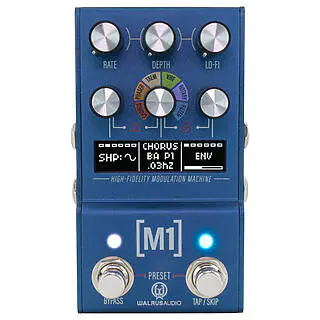



 Creative
 Delay
Delay
 Dirt
Dirt
 Dynamics
 Filter+EQ
 Lo-fi
Lo-fi
 Modulation
 pitch
pitch
 Reverb
 Synth
Synth
 Shopping Guides
 Stompbox Exhibit
 https://imp.i114863.net/c/2536674/794166/11319?u=https://www.sweetwater.com/store/search.php?s=walrus+M1+MKII[/caption]
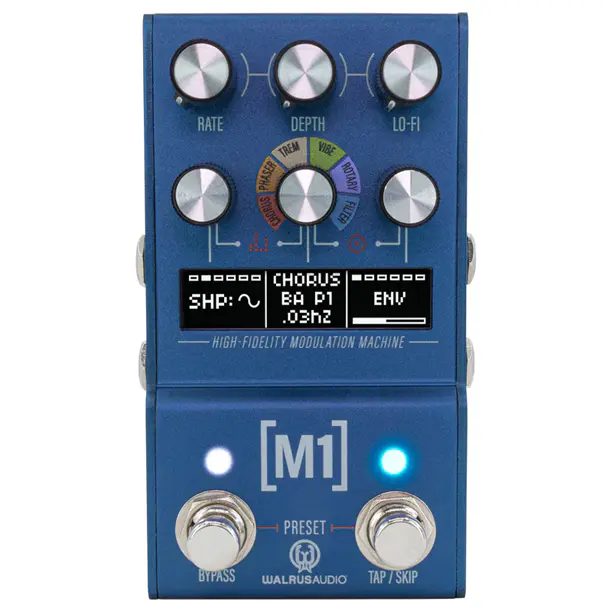
The Mako M1 MkII is the updated version of the company's "High-Fidelity Modulation Machine," part of the impressive Mako line of stereo, multi-algorithm pedals.... Click on the title for more
https://imp.i114863.net/c/2536674/794166/11319?u=https://www.sweetwater.com/store/search.php?s=walrus+M1+MKII[/caption]
The Mako M1 MkII is the updated version of the company's "High-Fidelity Modulation Machine," part of the impressive Mako line of stereo, multi-algorithm pedals.... Click on the title for more