Author Archive
Building on the original design in collaboration with guitarist Doug Weiand, the MORE v2 Harmonic Enhancer is a fully tube-driven box designed to elevate your entire rig without altering its core identity. Rather than serving as an overdrive or distortion, it functions as a genuine thermionic preamp stage. Running on a true high-voltage internal supply of around 340V—completely avoiding starved-plate compromises—it pairs a carefully selected NOS 12AV7 with a 12AT7 tube to infuse your signal with organic warmth, depth, and touch sensitivity. The pedal operates as an always-on enhancement tool: Harmonic Enrichment: Adds natural upper-harmonic richness, sustain, and clarity, making clean tones more dimensional and driven sounds tighter and more focused. Bass Cut Switch: Allows you to effortlessly tame low-end bloom and tighten up extended-range or high-gain setups without stripping away essential body. Flexible Integration: Wide-bandwidth tube circuitry preserves the full frequency spectrum, letting it sit comfortably in front of an amplifier, inside an effects loop, or at the end of a digital modeler and IR rig. Because it operates on authentic high-voltage tube power, the MORE v2 requires a robust power supply delivering at least 600mA at 9–12VDC. It isn’t built to fix a flawed signal chain; instead, […]... Click on the title for more
To mark a decade since their very first release, UK-based Flattley Pedals has revisited where it all started. Built as part of their handcrafted Platinum Range, the new Flattley Reaper 10 AE takes the op-amp core of the original 2016 Reaper and evolves it into a much more aggressive, rodent-inspired distortion machine. Rather than relying on a complex rotary feedback loop, the anniversary edition utilizes a straightforward three-way toggle switch to jump between three distinct gain architectures: Hard Clipping (HC): Employs vintage glass-envelope germanium diodes for an aggressive, biting crunch. Boost (BST): Bypasses all clipping stages entirely, serving up a high-headroom clean boost capable of pushing a tube amp preamp into natural saturation—or dialing up the gain control for its own organic push. Soft Clipping (SC): Uses asymmetric clipping paired with an LED and a conventional silicon diode for a smoother, touch-sensitive overdrive. Beyond the circuit, Flattley’s meticulous UK-handcrafted build shines through in the details. It features custom-etched 20 mm black anodized aluminum knobs, a matching purple-etched foot topper, and a signature stage-friendly purple halo light ring designed to diffuse glare under dark venue lights. It’s a thoughtful, beautifully finished nod to the company’s roots, packed with enough versatility to […]... Click on the title for more
Before shrinking their ecosystem down to the floor, Positive Grid built a massive reputation on software modeling and desktop practice amplifiers, most notably pioneering the BIAS amp-building software and the wildly popular Spark series of smart practice amps. Folding that same powerful technology into a portable floor processor, the Positive Grid Spark Pedal packs an entire guitar rig into a compact, gig-ready enclosure. Driven by the same HD Tone Engine found in Spark 2 Amp, it delivers everything from pristine boutique cleans to modern high-gain tones right out of the box. At its core, the pedal combines powerful amp modeling, EQ, and effects with hands-free performance tools designed to get you from a musical idea to a finished sound instantly. The control layout and feature set are organized as follows: Direct Onboard Controls: Five tactile knobs—including an Amp Type selector alongside Gain, Bass, Mid, and Treble—provide immediate, old-school tone shaping without needing a screen Dedicated Effects Section: Independent knobs for Drive, Mod, Delay, and Reverb allow for straightforward, hands-on adjustments to your spatial and gain textures. Dual-Mode Footswitches: Three heavy-duty steel switches operate in two distinct modes—Preset Mode grants instant access to six saved tones across two banks, while Looper […]... Click on the title for more
Stepping away from traditional, diffuse ambient washes, the Electronic Audio Experiments Scattering approaches spatial processing through a complex multi-tap delay network that feels refreshingly alive. Tracing its spiritual roots back to EAE’s earlier Hypersleep – which was ultimately limited by exhausted supplies of the rare MN3011 bucket brigade chip – Scattering utilizes a powerful Spin FV-1 digital architecture to bring those vintage-inspired, multi-tap ideas into a much more capable, modern format. It’s a hybrid instrument that balances a high-headroom analog dry path with 24-bit digital processing, ensuring your core tone stays crisp even when things get wonderfully chaotic. Shaping the sound is handled by seven primary controls spread across two rows, letting you dial everything from tight room tones to vast, disintegrating sonic voids. At its core, the pedal features four distinct algorithmic modes: X1 Mode: Directly ports the six tap lengths from the classic MN3011 BBD architecture. X2 Mode: Doubles those tap lengths to push the pedal deep into expansive, long-delay territory. Matrix Mode: Runs eight total delay lines (four per side) through a Feedback Delay Network (FDN), providing enough stability to hold a true infinite reverb. Nonlinear Mode: Employs a swelling envelope applied directly across the delay taps […]... Click on the title for more
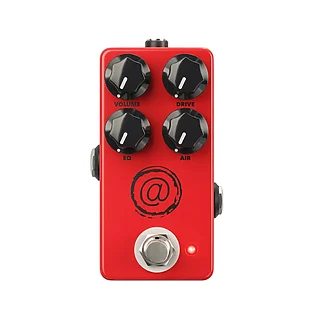
The JHS AT Mini is a (more than) compact – but not quite mini – version of the company’s renowned overdrive AT+ pedal developed with guitarist Andy Timmons to deliver his signature dynamic drive tones in a space-saving format. Like the original, it delivers a versatile range of sounds, from subtle edge-of-breakup textures to rich, saturated lead tones. Its high touch-sensitivity ensures playing dynamics and guitar volume dictate the sound, allowing seamless transitions from clean to driven without losing articulation. Besides the size, compared to the V2 of the original version, the AT Mini has two main differences: No Wattage Toggle: The 3-way wattage switch found on the larger model (which allowed users to toggle between 25W, 50W, and 100W voicings) has been removed. Instead, the AT Mini is permanently fixed to Andy Timmons’ preferred 100-watt mode, which is his go-to open, loud, and less-compressed setting. No Independent Boost: The separate footswitchable boost channel and its dedicated boost control knob are gone, leaving only the core overdrive circuit and its original four control knobs (Volume, Drive, EQ, and Air). Whether used as an always-on boost, a dynamic rhythm foundation, or an expressive lead overdrive, the pedal fits comfortably on crowded […]... Click on the title for more





 Creative
 Delay
Delay
 Dirt
Dirt
 Dynamics
 Filter+EQ
 Lo-fi
Lo-fi
 Modulation
 pitch
pitch
 Reverb
 Synth
Synth
 Shopping Guides
 Stompbox Exhibit

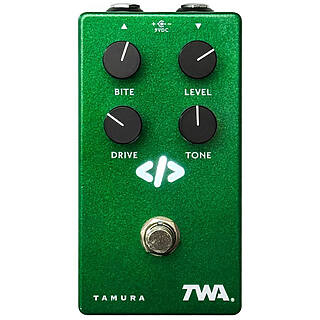
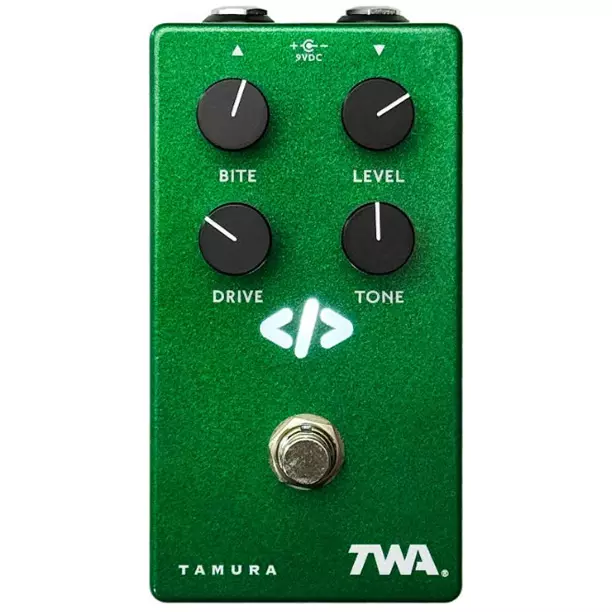 For decades, the TubeScreamer has been a staple on pedalboards worldwide. Now, prepare for its ultimate evolution. Totally Wycked Audio has unveiled the Source Code, a next-generation soft-clip overdrive designed by none other than Susumu Tamura, the original creator of the legendary TS808.... Click on the title for more