Author Archive
Continuing the Italian builder’s obsession with capturing elusive D-style tube amp response, the Cornerstone Gladio MkIII elevates the flagship double preamp that built the brand’s reputation. Designed and hand-built in Varese, Italy, the MkIII retains the core dual-channel architecture inspired by the dynamic touch sensitivity of rare Dumble-style circuits, while completely rebuilding the pedal around key player requests. Core Voicing Consistency The MkIII preserves the fundamental dynamic separation between its two preamps. Channel 1 remains the smooth, transparent, edge-of-breakup voice inspired by Robben Ford, delivering clean-to-dirty breakup based purely on pick attack. Channel 2 continues as the midrange-forward, harder-clipping voice inspired by Sonny Landreth. Both channels now feature dedicated Compression toggles to switch between tight/controlled and open/touch-reactive feel. Critical MkIII Upgrades Where the original Gladio (retired in 2022) relied on internal adjustments and fixed routing, the MkIII exposes full control to the front panel and expands hardware flexibility: Channel 2 Ratio Control: A major overhaul to the harder-clipping channel, this clean blend mixes the dry input signal in parallel with the overdrive, restoring transient attack and string definition without sacrificing gain. External Bass Control: The bass response—previously locked behind an internal trimpot—is now an improved, external front-panel knob for instant […]... Click on the title for more
Released in October 2026, the Big Business by Morristown, New Jersey boutique builder Turbulent Audio is a versatile three-band EQ and dual-footswitch boost created to solve the limitations of traditional tone-shaping tools. Dissatisfied with interactive amp controls, fixed graphic bands, and complex parametric sweep points, Turbulent Audio engineered it with user-adjustable crossover points, broad frequency responses, and completely independent bands. Running on an internal 18V rail for massive headroom, the circuit pairs a broadband gain circuit with a dedicated, independently switched clean boost that slams the front end of tube amps or downstream drives without introducing unwanted pedal-level distortion. As highlighted in the demo belowby collector // emitter, this high-headroom architecture makes it a powerhouse for ambient and shoegaze setups. Whether used as an always-on preamp to recover long-chain signal loss, a targeted mid-boost for solos, or a tail-end sculpting anchor that prevents heavy reverberant washes from collapsing into mud, Big Business delivers predictable, mix-cutting clarity across your entire pedalboard.... Click on the title for more
Bringing the core foundation stage of the company’s Triptychon to a standalone format, the Crazy Tube Circuit’s Rapture condenses the response of a cranked tube amplifier into a dedicated low-to-medium overdrive. Designed to capture a tube circuit at its operational sweet spot, it focuses on organic dynamic compression, rich harmonic development, touch-sensitive pick attack, and a seamless transition from pristine clean to smooth edge-of-breakup drive. Rather than relying on harsh diode clipping, Rapture retains the Triptychon’s foundational drive topology while introducing two interactive toggles—MORE and MOD—that dynamically modify headroom, gain structure, and overall compression. Base Voice (MORE & MOD Down): Replicates the original, unaltered drive circuit of the Triptychon. MOD Switch (Up): Shifts the circuit into a more open, high-headroom response. This mimics the feel of adding a second pair of power tubes and a heavier output transformer, preserving low-end clarity and dynamic range. MORE Switch (Up): Directly interacts with the main Gain control and the MOD setting, pushing the gain structure into punchier, more assertive territory without altering the core frequency profile. Rather than acting as separate, disconnected channels, these toggles function as flexible gain-staging tools for dialing in subtle, pushed variations of the same underlying amp voicing. Engineered […]... Click on the title for more
Combining some of JHS’s two most enduring circuit designs—the Marshall-inspired Morning Glory V4 and the Bill Finnegan-derived NOTAKLÖN (featuring the Boston-nodding “Shamrock” mod)—the JHS Wanderer represents a structural leap forward for the dual-overdrive format. Housed in a compact vertical chassis with top-mounted jacks and power (9VDC, 165mA) with silent soft-touch switching and buffered bypass, it solves the traditional rigidity of two-in-one pedals by offering four individual I/O jacks. Using the main outer jacks, it functions as a standard series pedal with a center Order Toggle to swap circuit placement. Using all four jacks isolates both sides completely, allowing you to patch compressors, fuzzes, or entire switcher loops between them. Each side features its own dedicated Red Remote jack, enabling external latching footswitches or MIDI switcher amp-control outputs to remotely flip the onboard performance toggles. This unlocks four independent gain stages: Morning Glory Side: Features Volume, Drive (which adds brightness as it increases), and Tone controls. The Gain Toggle switches from standard transparency to a high-gain mode (signaled by a red LED) that brings in a full additional gain stage with a volume boost and fuller response. An inset Bright Cut switch tames high-end frequencies if needed. NOTAKLÖN Side: Features Volume, […]... Click on the title for more
Handcrafting small batches in a Northamptonshire garden workshop, Markus and Izzy engineer fuzz circuits that bridge vintage lineage with modern reliability. As a deliberate homage to the rare John Hornby Skewes MK1 Zonk Machine and its MK1 Tonebender cousin, their Reeves Electro Z1 meticulously reconstructs the original three-transistor architecture—with a twist. By employing a matched set of vintage New Old Stock Mullard/Philips BC108C silicon transistors alongside carefully measured support components, the design captures that elusive, aggressive MK1 bite entirely free from the temperature-dependent fuzz-out that plagues germanium units. Designed with an intentionally spacious layout to prevent component crosstalk and ear-bleeding high-frequency sizzle, the circuit is hand-assembled on a vintage-spec brown phenolic resin board using premium Alpha pots, JB capacitors, and Lumberg jacks. Sculpted Controls: Features a high-output Swell volume knob, an Attack control that doubles as a dynamic bias adjust for gated compression or crumbly decay, and a dedicated Sensitivity knob to fine-tune the primitive, crackling front-end gate of the original circuit. Voicing Toggle: Includes a Zonk/Thick switch to instantly toggle between a tight bass-cut profile and a fatter MK1 response. Aesthetic Finish: Each enclosure features a unique, hand-etched gunmetal patina created via an acid-etching process, verified individually by ear […]... Click on the title for more
Just when you thought the universe had manufactured enough stamped-aluminum boxes to choke every basement guitarist from here to purgatory, a brand called Gigagain crawls out of the woodwork waving a Marshall-in-a-box named the “Golden Legacy.” It retails for roughly a hundred and twenty-nine bucks. For that price, what do you get? A 320-gram chunk of aluminum alloy housing an analog circuit that refuses to apologize for wanting to sound like Great Britain’s finest stack-amp noise. They slapped a three-band EQ on it—Bass, Middle, Treble—plus your standard Gain and Volume pots, and a toggle switch that swings between two moods: Vintage (for that grainy, loose, early-pushed power-amp rattle) and Modern (for a tighter, compressed, higher-gain squeeze). The curious little engineering quirk? A literal physical power switch right there on the pedal. Click it to off, and it completely severs the circuit so it stops bleeding your 9-volt dry while it sits dormant on your board. Is it going to rewrite the gospel of rock and roll? Probably not. It’s a buffered bypass distortion box built to chase the ghost of every loud British amp that ever blew out a teenager’s eardrums. But in a marketplace bloated with boutique nonsense priced […]... Click on the title for more
Page 1 of 340 1 2 3 4 5 ... 10 20 30 ... Next Last »





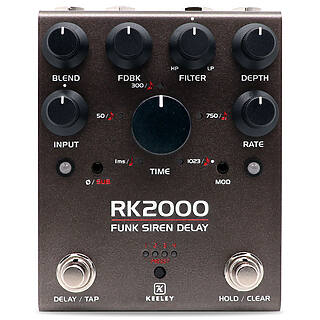
 In 1983, Ibanez/Maxon built something absurd: the DM2000, a 12-bit digital delay so over-engineered that it made everything else look like a toy. Forty years later, Trey Anastasio has been abusing one onstage, using its Hold function to create infinite, warbling loops called the "Funk Siren." The only problem? Vintage units are dying. Justin Stabler, Trey's guitar tech, begged Keeley to save him the heartache.
The Keeley RK2000 is that rescue mission.... Click on the title for more
In 1983, Ibanez/Maxon built something absurd: the DM2000, a 12-bit digital delay so over-engineered that it made everything else look like a toy. Forty years later, Trey Anastasio has been abusing one onstage, using its Hold function to create infinite, warbling loops called the "Funk Siren." The only problem? Vintage units are dying. Justin Stabler, Trey's guitar tech, begged Keeley to save him the heartache.
The Keeley RK2000 is that rescue mission.... Click on the title for more

 If you are a pedal lover and you are not familiar with Hologram Electronics, well, you aren't really a pedal lover. The Nashville-based company has been churning out incredibly creative pedals for over a decade now, with the latest (the Microcosm) becoming a stellar bestseller. They just unveiled their next device, the Chroma Console Multi-Effector.... Click on the title for more


 The
The