




Red Panda has spent years proving that digital doesn’t have to mean cold. The Raster was their deep-dive pitch delay – a brilliant box with menus, alternate functions, and enough parameters to make a synth programmer weep with joy . It was also, for the stomp-and-go guitarist, a lot.
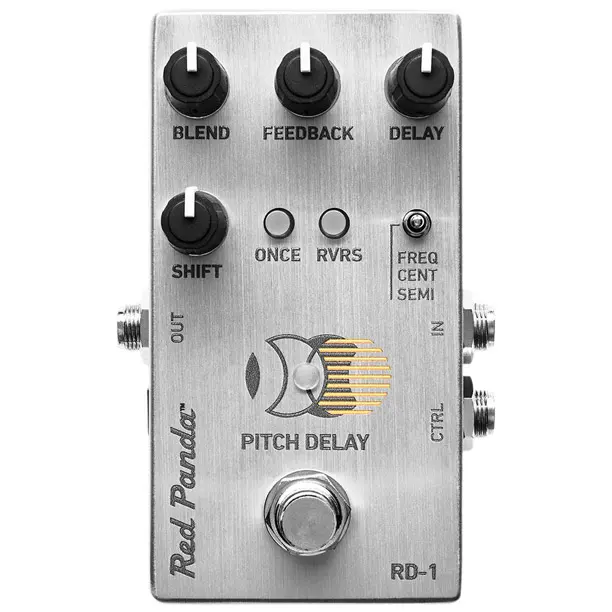
Enter the Red Panda RD-1. Same DNA. Half the complexity. All the weird.
What you get is a pitch-shifting delay stripped down to essentials.
Three Shift modes:
- Freq: Measures pitch in frequency values. Small tweaks yield detuning and ring-mod textures; larger sweeps produce alien squeals and intervals outside any scale. Experimental territory.
- Cents: Measures in 100-cent increments for precise musical intervals or microtonal adjustments. A few cents create chorusing and tape warble; exact values deliver clean harmonies.
- Semi: Traditional pitch-shifting for predictable harmonies: thirds, fifths, octaves. No surprises, just musical intervals.
Range from ±500Hz, down a fourth, up a major third, or ±12 semitones . Want shimmer that doesn’t sound like every other shimmer? Dial in cents. Want pitch-shifted repeats that spiral into another dimension? It can do that too. (The Once switch controls whether the pitch shift repeats or not).
The clever bit is in the behavior. Repeats can shift once and hold, or keep shifting every repeat, turning a simple phrase into a descending/ascending fractal that never lands . Throw the Reverse switch and suddenly your delays are arriving backwards – up to 2400ms of it, because time apparently bends differently when you’re moving in reverse.
Delay time, Feedback, Blend – three expected control, plus the Shift knob setting the amount of pitch change applied to the delayed signal. The CTRL input takes expression or tap tempo. USB-C for updates, but no MIDI—this one’s for people who want to twist knobs in real time, not menu-dive
The Raster was for architects. The RD-1 is for players. Same sound world, no manual required. Plug in, turn knobs, let the wormholes open.