




Fairfield Circuitry has built a reputation for crafting pedals that marry utilitarian design with bold, unconventional tones. Their latest offering, the 20% More Limiting Distortion, is no exception—a wryly named yet seriously effective take on saturated, compressed dirt.
An unorthodox take on fuzz, the 20% more blends synth-inspired circuitry with guitar-friendly mayhem. At its core is a slew limiter, a circuit typically used in modular synths to shape control voltages. Here, it acts as a dynamic low-pass filter, distorting audio in unpredictable, organic ways.
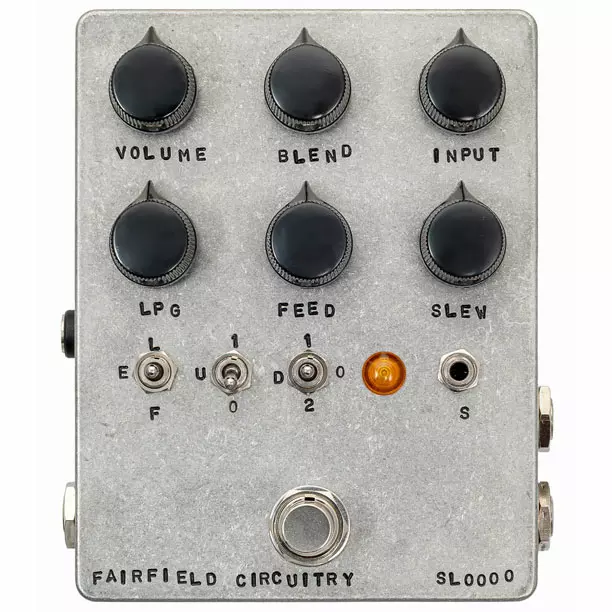
The Slew control adjusts how aggressively the pedal clamps down on fast signal changes, creating anything from smooth saturation to gated, splattery decay. Crank the Feed knob, and the circuit begins to self-oscillate, injecting jagged triangle-wave harmonics. Meanwhile, the Blend control mixes in a raw square-wave copy of your signal (plus optional sub-octaves or rectified upper octaves) for added texture and bite.
What truly sets 20% More apart is its envelope follower, which dynamically adjusts either the Feed amount or the output’s low-pass gate (LPG) based on your playing intensity. Dig in, and the pedal responds with shifting harmonics and compression; play softly, and it cleans up without losing character.
Three toggle switches control key aspects of its distortion and filtering behavior. Here’s what they do, based on official specs and confirmed functionality:
- E Switch = ENV DEST – Selects whether the internal envelope follower modulates:
• FEED (adjusts the resonance/self-oscillation from the Feed control)• LPG (controls the cutoff frequency of the low-pass gate at the output) - U Switch = FULL WAVE – Activates a full-wave rectifier circuit, which produces an upper-octave effect by doubling the frequency of the input signal, adding grit and harmonic complexity.
- D Switch = SUB – Engages analog sub-octave generation:
• 1 (adds a sub-octave one octave below the input signal)• 2 (adds a sub-octave two octaves below)• 0 (no sub-octave)
These switches work alongside the pedal’s knobs to create everything from dynamic, envelope-sensitive fuzz to synth-like tonal mutations.
With expression control, internal trim pots, and a sensitivity to input volume, this pedal rewards experimentation. Whether you’re sculpting synth-like growls, velcro-fuzz chaos, or just “20% more” of everything, Fairfield’s latest proves that distortion can still be reinvented.