




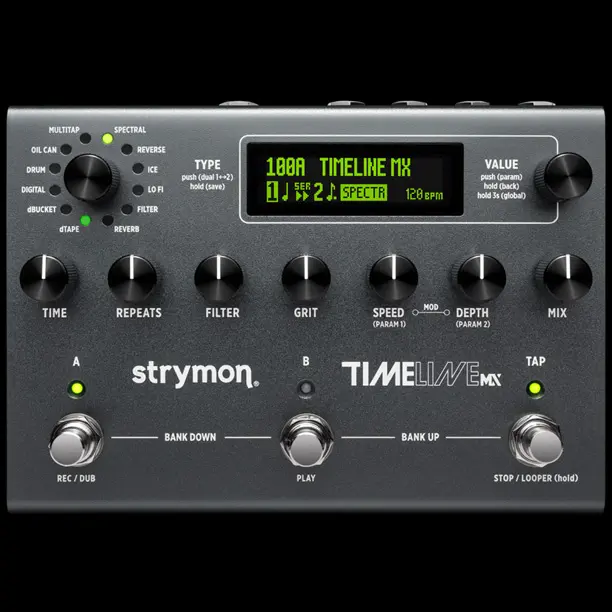
When it came out, the Timeline was the delay pedal that made other delay pedals feel like toys. The Strymon Timeline MX doesn’t replace it — it mutates it.
The original’s twelve machines are still here — dTape, dBucket, Digital, Dual, Pattern, Reverse, Trem, Filter, Diffuse, Ice, Duck, and Lo-Fi — but they’ve been rebuilt from the ground up. More headroom. Better fidelity. The same familiar sounds, just deeper and cleaner than they had any right to get.
But the new stuff is where it gets interesting.
Five new engines that weren’t in the original.
- Oil Can is the one that’ll stop you mid-play. It models the warble and compression of those old oil can delay units — the ones that were obsolete before most of us were born. It’s greasy, it’s unstable, and it sounds like a machine that’s trying to remember how to work.
- Spectral is something else entirely. It breaks your delay repeats into frequency bands and lets you process them independently. Think shimmer without the cliché — ethereal without being saccharine.
- Drum is a modeled analog delay based on a drum echo unit. It’s darker, punchier, more percussive than the tape models. Slapback on this thing hits different.
- Multitap gives you up to eight independent delay taps with individual control over panning, feedback, and level. It’s the kind of rhythmic complexity that used to require a rack unit and a MIDI controller.
- And then there’s the Reverb engine. A dedicated, flexible reverb that lives alongside the delays, not after them. You can run it in series, parallel, or use it as its own effect. The Timeline always needed a good reverb to pair with it. The MX just built one in.
Dual delays, for real this time.
The original Timeline had a Dual mode, but the MX lets you run any two machines simultaneously — not just the same algorithm twice. You can route them in series, parallel, or pan them left and right. Digital into Oil Can. Drum into Reverse. Spectral into a clean delay with the reverb washing over both. It’s not a feature. It’s a different way of thinking about delay.
The looper grew up.
The original looper gave you 30 seconds. The MX gives you five minutes of stereo looping with a new one-button mode alongside the original multi-button operation. Half-speed. Reverse. Undo. It’s a proper looper now, not an afterthought. You can build full arrangements on the pedal itself and layer delays on top without eating into your loop time.
Everything else.
300 presets. Full MIDI over TRS and USB-C. Selectable true bypass or buffered with trails. The same form factor, the same footprint, the same build quality. It fits on the same board the original lived on, but it does about twice as much.
The Timeline MX is not a refresh. It’s a reimagining of what a delay workstation can be, built by people who clearly spent a lot of time thinking about what the original couldn’t do — and fixed all of it.