




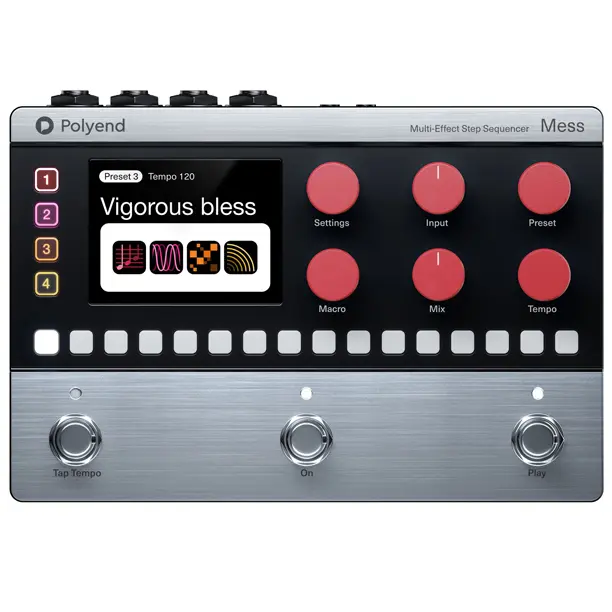
Polyend saw the pedal world and decided it needed more chaos. The Mess is their answer: a multi-effects pedal with four independent tracks, over 120 stereo effects, and a 16-step sequencer that turns static processing into something alive. It’s a box that can treat your tone with surgical precision one moment and shred it into shimmering debris the next.
The core concept is simple. Four effect lanes, each freely assignable to any of the 125 algorithms—reverbs, delays, granular engines, pitch shifters, spectralizers, shapers, and enough modulation to make a modular user blush. Run them in series, parallel, or dual parallel. Keep them static, or hit the sequencer and watch your sound start moving.
The sequencer is the Mess’s reason for existing. Each track runs independently, with its own speed, length, and step probability. You can slow one effect to a glacial crawl while another spits micro-loops in frantic stutters. Per-step parameter control means delay times jump, filters sweep, and reverbs bloom exactly where you want them. Polyrhythms, polymeters, randomized repeats, tap-tempo sync—it’s a rhythmic playground for people who think effects should dance.
Polyend claims 125 effects. Realistically, it’s 11 core types with deep sub-modes—25 reverb variations alone. The Spectralizer modes are genuinely weird, the Granular Bust engine transforms audio in real time, and the Particle Sampler captures audio from selected steps and replays it rhythmically. Some users report the reverbs feel a bit digital, and the gain staging requires attention, but the creative upside is undeniable.
150 factory presets, space for 1,000 of your own. Expression input, MIDI over TRS Type B, USB-C, microSD slot. No power supply included, which at $599 feels stingy. The single stereo input jack is another odd choice for a pedal this ambitious.
Turn off the sequencer and it’s a deep, flexible multi-effects unit. Turn it on, and the Mess becomes something else entirely: a generative texture machine that rewards tinkering and punishes predictability. For guitarists who think effects should move, this is a compelling box. For everyone else, it might just be a mess.