




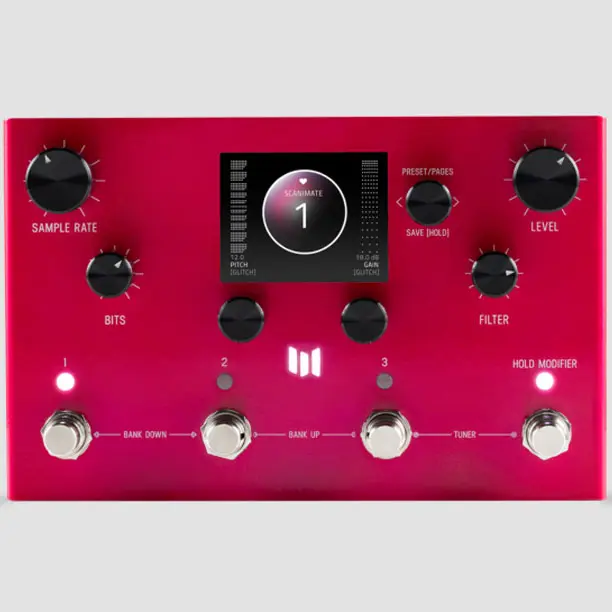
Some pedals evolve. The Meris Ottobit X resurrects – louder, stranger, and fully reborn.
Meris took the Ottobit Jr. and Ottobit Sr.—their vintage gaming-inspired glitch boxes—and injected them with enough ’80s nostalgia to fill a John Hughes marathon. The result is a full stereo modular degradation engine that doesn’t just destroy your signal. It resurrects it, corrupted, in a new form.
The new stuff:
The Effects:
- Six glitch types including Grain Freeze, Stutter, Tape Stop, and two one-button loopers: Push Loop and Wikki Wikki (real-time vinyl scratching).
- The VHS Delay and VHS Reverb are entirely new, with play speed manipulation that sounds like a tape machine dying beautifully.
- Five pitch types.
- Five modulation types including Ring Mod, Freq Shift, and Otto Vibe.
- Four preamps: Volume Pedal, Tube, Vinyl, and Wavefold.
- Three filter types including the new Otto Tron.
The brain: The sequencer jumped from 6 steps to 16, assignable to roughly 48 parameters. Ninety-nine preset locations. Eighteen artist presets. A full-LCD color screen adapted from LVX and MercuryX. Dim everything if you hate lights on your board.
The guts: Premium Analog Devices JFET input section. 24-bit AD/DA with 32-bit floating point DSP. Digitally controlled analog mix bus. Stereo in and out. MIDI over DIN or USB-C. Designed and built in California.
More stuff: And we really don’t have the time here to deal with the Expressive Hold Modifier Switch, the Favorite Preset Bank for three instant-access slots, the built-in tuner, the deep Modifier Section for routing control signals, switchable Instrument/Line headroom, and the Advanced ARM processor… Oh and! The crush section has Volume Scaling and Dry Blend now, and the modulation list includes Div Trem and Tape Mod…
The price: $599. Standard run in matte black. Limited edition in Multidimensional Pink—final sale, no returns, no whining. Ready to ship now.
The real question: Do you need an Ottobit X? No. No one needs a pedal that does real-time vinyl scratching while running your signal through a VHS reverb through a wavefold preamp through a 16-step sequencer. But if you’ve ever wanted to sound like a Commodore 64 that got struck by lightning at a roller rink in 1986, this is your box. And if you’re that kind of player, it just might coax a new muse out of hiding.
It’s a lot. It’s a lot of money and a lot of pedal. But it’s also the only thing that does what it does, and it does it better than whatever you’re imagining.