



A thousand dollars. For a delay pedal. Let that sink in.
Here’s the thing, though. Joel Korte and his team and John Snyder (Electronic Audio Experiments) have built something that actually justifies the price tag. The Chase Bliss Big Time isn’t another digital delay with fancy marketing. It’s a painstaking recreation of how early ’80s rack units actually worked: crude digital systems propped up by advanced analog engineering. PCM 70. SDD-3000. The ones that sounded magical because their limitations forced happy accidents.
The architecture is genuinely unique.
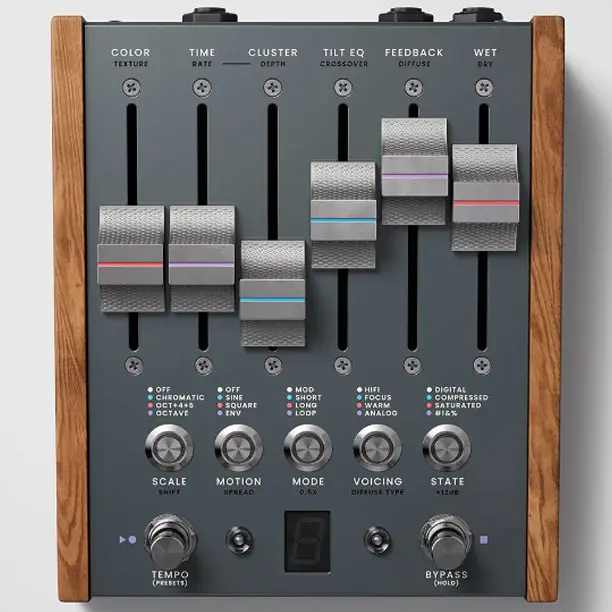
A stereo analog preamp hits the input stage: adjustable gain, clipping, real saturation.
Then a stereo analog limiter lives inside the delay’s feedback loop. Not after the repeats. In the loop. Every echo passes back through it, degrading and morphing in ways digital modeling can’t touch.
The limiter has four States:
- Digital (clean),
- Compressed (controlled sag),
- Saturated (accumulating clipping),
- and the gloriously named “#!&%”—misbiased, unstable, unpredictable.
Four Voicing modes (Hi-Fi, Focus, Warm, Analog) shape the filter response.
Four Motion modes (Off, Sine, Square, Envelope) handle modulation. Scale does pitch and timing tricks – Thermae fans, take note – including Chromatic, Oct+4+5, and Octave.
Six motorized faders recall positions when you switch presets. The sliders move. By themselves. It’s ridiculous and wonderful. Up to 12.2 seconds of delay time, 3.2 minutes of looping. True stereo I/O, balanced or unbalanced. MIDI, CV, expression, aux switching. 32-bit/48kHz conversion.
$999. 1,099 in Europe. Most expensive Chase Bliss ever.
For players who want the anything-is-possible of digital and the everything-sounds-good of analog, this is the one. For everyone else, there’s always the used market. Eventually.