




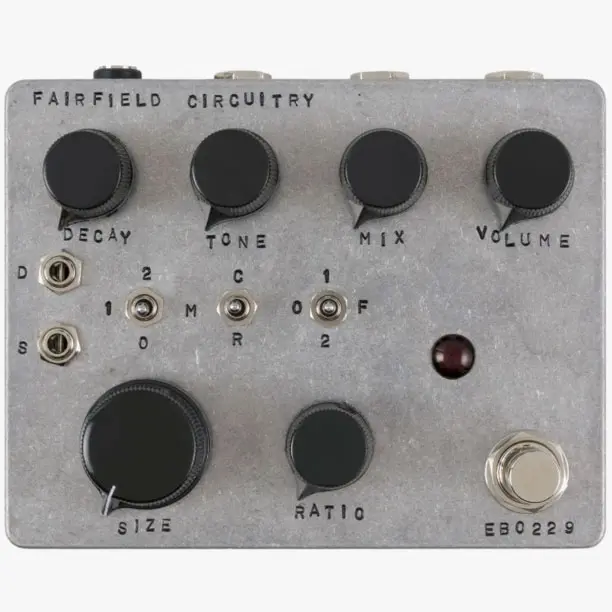
Quebec prides itself with being different, and the province’s most prominent pedal maker has always done things a little sideways, with devices that don’t sound quite like anybody else’s. The Fairfield Circuitry Placeholder keeps that streak alive. It’s an analog reverb built around BBD chips, but it’s not trying to be a spring or a plate or anything you’ve heard before. It’s trying to sound like digital reverb, using analog parts, and the result is something that doesn’t really have a category.
The core of it is something called a Householder reflection feedback matrix. That’s a fancy way of saying it uses BBDs to create a bunch of very quick repeats that bounce around and trick your ear into hearing a room. It’s nostalgic and alien at the same time — familiar enough to feel like a space you’ve been in, weird enough that you can’t quite place where.
The controls give you a lot to work with:
- Size sets the room size.
- Ratio scales two additional delay lines relative to the one Size controls, so you can go from subtle shimmer underneath your playing to big echoing halls.
- Decay adjusts the gain of each feedback path, from a single reflection all the way up to full self-oscillation if you want it to sing.
- Tone is a single-knob tilt filter — darker one way, brighter the other. Mix and Volume round it out.
Then there’s the extra stuff. Three-position switches for modulation depth and waveshape, including random modulation. Another switch for low-pass filtering to tame high-end bite. Two CV inputs for Decay and Size, so it plays nice with modular gear. A dedicated mono Hi-Z input that can be switched to line level with an internal jumper. And an FX insert loop that lets you drop other pedals into the feedback path — which is where things can get properly unhinged.
It’s weird in the best way. Not a reverb for people who want their amp to sound bigger. A reverb for people who want to hear a room that doesn’t exist.