




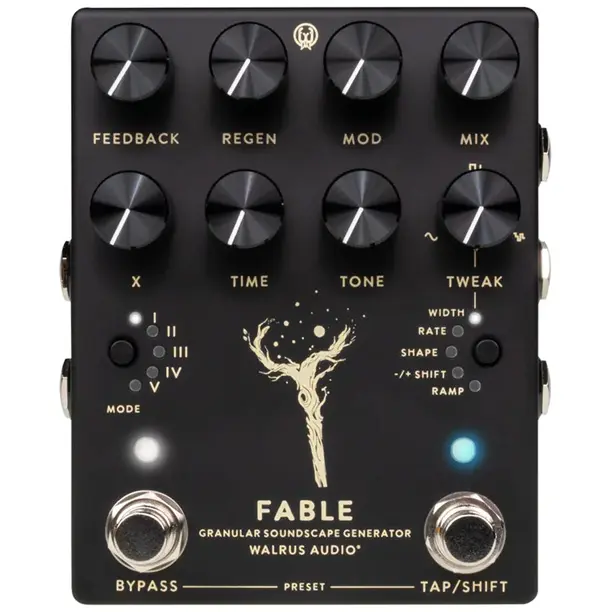
Evolving from a beloved mono ambient tool into a fully realized spatial processor, the Walrus Audio Fable MkII ($349.99) takes the core experimental architecture of the original 2023 granular delay and supercharges it for modern rigs. While the first-generation Fable captured imaginations with its five distinct dual-effect algorithms—pairing delays with granular processing paths—it was constrained by a mono I/O footprint.
The MkII addresses this head-on by migrating to Walrus Audio’s proprietary in-house MDSP platform, introducing true stereo operation that allows wet granular textures to bloom across a wide soundstage. Beyond spatial widening, the control interface receives a massive expansion via a multi-functional Tweak control. Players can now dive beneath the surface to adjust stereo
- Width,
- Modulation Rate (0.1 Hz to 5 Hz),
- Modulation Shape (sine, square, or random),
- Shift intervals, and
- Ramp times.
The core core DSP concepts for the five programs remain structurally consistent between iterations— pairing a dual-stage delay engine with a granular processing buffer. However, the fundamental way they render audio changed dramatically in the MkII:
-
True Stereo Processing & Panning: On the mono MkI, both feedback paths collapsed into a single centered channel. In the MkII, the dual feedback loops (Delay and Granular/Regen) operate across a true stereo soundstage. The grains, pitch shifts, and reverse taps actively cross-feed and spread between the left and right channels rather than stacking in a single channel.
-
Clock-Stretching in Mode IV (Grain-Verb): In the original MkI, Mode IV operated as a fixed dual multi-tap grain generator. In the MkII, the
Timeknob and incoming MIDI clock actively control time-stretching across both granular algorithms simultaneously, altering both buffer length and tonal grain density on the fly. -
Dynamic Sample-Rate Modulation (Modes I–V): All five programs in MkII now interface directly with the expanded Dive/Rise pitch system and secondary LFO shapes, giving each mode the ability to warp pitch and sample rate smoothly via the new
ShiftandRamparchitecture.
Performance flexibility is further amplified by upgraded hardware integration:
-
Expanded Preset Management: Provides three onboard hardware preset slots (plus a Live white-LED mode) alongside full access to 127 recallable presets via MIDI.
-
Comprehensive Connectivity: Adds full MIDI In/Thru via compact jacks, expression pedal mapping, external tap functionality, and a USB-C port for firmware updates.
-
Real-Time Clock Manipulation: Retains and refines the momentary Dive/Rise function, letting players bend sample rates and pitch behavior on the fly.
By shedding its mono limitations and integrating deep MIDI and stereo architecture, the Fable MkII transforms from a quirky tabletop-style noisemaker into a deeply integrated, professional soundscape generator.
Walrus Audio Fable MkI

The Walrus Audio Fable, presented by the Oklahoma City builder as a “granular soundscape generator,” is a pedal developed on the successful platform of the Lore, the company’s reverse soundscape generator released in 2022.
Needless to say, the keyword here is “granular,” a sample synthesis technique that records your performance into a buffer (i.e. RAM memory) and splits it into “snippets” that are then rearranged more or less randomly – the company calls the programs governing this process “sample and chop algorithms.” There are five of them inside this pedal.
The Fable can be filed under the granular delay category, and it’s the first pedal of this kind released by Walrus Audio. It puts it in the company of a small group of forward-thinking builders like Chase Bliss Audio, Red Panda, Hologram Electronics and Montreal Assembly, who arguably started the granular craze in the mid ’10s with the Count to 5.
The Fable offers five modes based around granular delay that broaden the sonic palette offered by this effect:
- Reverse Delay into Reverse Granular: sampled grains (i.e. snippets of your performance) are played backward.
- Forward Delay into Octave Up Granular: sampled grains are played at double speed.
- Analog-Style Delay into Octave Down Granular: sampled grains are played back at half speed.
- Multi-Tap Granular into Multi-Tap Granular (Grain-Verb): two multi-tap granular algorithms run in series, and multiple samples are played back from each granular buffer simultaneously, creating glitchy clouds and unique organic reverberance. In this program, the Time knob controls time-stretching of both granular algorithms.
- Forward Delay into Randomized Pitch Granular: each grain is played back at a randomly selected speed and direction, varying between pitched up double speed, pitched down half speed, normal speed, plus forward and reversed playback from grain to grain.
Each mode can be tweaked via 5 knobs with a set function (Feedback, Regen, Mode, Time, and Tone) and one with a variable one depending on the mode (X).
Check out the inspiring sounds produced by the Fable in the videos below. We added it to our article about the best experimental and psychedelic delay pedals.
Walrus Audio Fable Granular Soundscape Generator, Builder’s Notes
Let your storybook adventure grow with the Fable Granular Soundscape Generator. The Fable creates new sonic adventures with five granular delay programs centered around sample and chop algorithms creating bizarrely beautiful networks of sampled and resampled sounds
In the high woodlands of the north, undiscovered by most inhabitants, there ruled a clan of old, mystic Treefolk. On the first new moon of spring, these Treefolk could be heard grafting limbs to grow their young – splicing bits of branches from each generation to produce the next line of Treefolk. These new beings keep the lifeblood of all who came before in their new skin. These sounds are in part very old but in part very new. They are referred to as… Fable.
Let your storybook adventure grow with the Fable Granular Soundscape Generator. The Fable creates new sonic adventures with five granular delay programs centered around sample and chop algorithms. The Fable generates its wonder with a dual feedback path developed by DSP engineers at Walrus Audio. With two DSP chips, your signal is run through two separate effects in series (independently controlled by the Feedback and Regen Knobs), then the signals are run back through both DSP chips again before going through the output. What does that mean? Artists will discover unique soundscapes ranging from smooth, flowing ambience; to bizarre, organic reverberance; to chaotic, glitchy swarms.
What exactly is this granular effect and why is it a magical experience when combined with delay? Granular is a digital processing technique of micro-sampling, wherein short samples called grains are read from a delay buffer. In the Fable, players can adjust these grains by manipulating their sampling length, position, and buffer size from which they’re read. They can be played at double or half speed for pitch shift and time stretching effects, play them in reverse, read from multiple positions, and more, to achieve different effects.
It’s a powerful but complex technique and we’ve created five streamlined programs in the Fable that explore different aspects of its sonic range.
Programs
I. Reverse Delay into Reverse Granular
Program 1 runs a reverse delay into a reverse granular algorithm, in which sampled grains are played backwards. Reversal and re-reversal build up in the feedback paths, creating a complex and organically shifting soundscape. Turn grain size down for long, smooth reversed transients, and grain size up for stuttering reverse glitch madness.
II. Forward Delay into Octave Up Granular
Program 2 runs a forward delay into an octave-up granular program, in which sampled grains are played at double speed. Swarms of double-speed grains build up in the feedback path for bright and airy cascades of sound.
III. Analog-Style Delay into Octave Down Granular
Program 3 runs a warm, dark analog-style delay into an octave-down granular program, in which sampled grains are played back at half speed. Slowed down repeats combined with analog-style processing to create deep, thunderous footfalls and thick, murky ambience.
IV. Multi-Tap Granular into Multi-Tap Granular (Grain-Verb)
Program 4 runs two multi-tap granular algorithms in series, in which multiple samples are played back from each granular buffer simultaneously. Multiple points of sampled sound build upon each other in the feedback paths to create glitchy clouds and unique organic reverberance. Time in this program controls time-stretching of both granular algorithms, changing both the length and tonal character of the granular effect.
V. Forward Delay into Randomized Pitch Granular
Program 5 runs a forward delay into a randomized pitch granular program, in which each grain is played back at a randomly selected speed and direction, varying between pitched up double speed, pitched down half speed, normal speed, plus forward and reversed playback from grain to grain. Pitch changes with each new grain, so play with the X knob in this program to control the rate of randomized pitch modulation.