




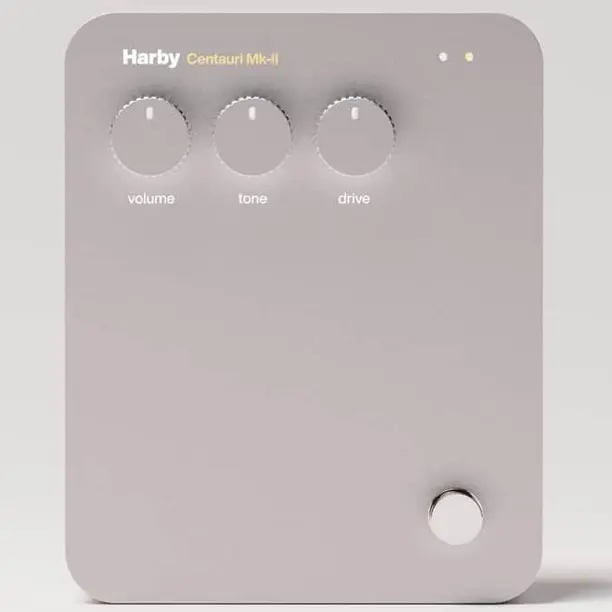
In 1994, Bill Finnegan built eight thousand magic boxes, coated them in epoxy so nobody could peek inside, and changed guitar tone forever. Thirty years later, original Klon Centaurs trade for seven grand, and the epoxy didn’t stop anyone forever—just slowed them down until 2009, when Martin Chittum finally scraped one clean and the internet got the schematics .
Harby Pedals, out of Idaho, has been studying those schematics ever since . The Centauri MkII is their latest refinement. Precision-milled aluminum enclosure, gold-plated ENIG circuit board, thin-film Japanese resistors, Class 1 capacitors from Japan . Genuine Texas Instruments TL072 op-amp. TC1044 charge pump doubling voltage internally to 18v for headroom .
And the diodes. This is where Klons live or die. Finnegan used 1N34a germanium, said they were “the most important factor” in how the circuit sounds . Harby tracked down original new-old-stock 1N34a’s with the correct 0.35v forward voltage (±15%, because germanium is never perfect) . That’s not marketing. That’s archaeology.
Three knobs. Volume. Drive. Tone. Buffered bypass, same as the original, so it’s never truly off—always doing that thing where your rig just sounds more . Drive down is clean boost, sparkle and presence without pushing the amp. Drive up is that creamy, compressed, harmonically-rich midrange that made the Centaur a legend .
Harby won’t claim it’s a perfect match. Finnegan himself said Centaurs varied unit to unit . But they’ve followed his specifications, used the same parts, built it in America . The epoxy’s gone. The price tag’s gone. The sound’s still there.
—
Harby Pedals Centauri MkI
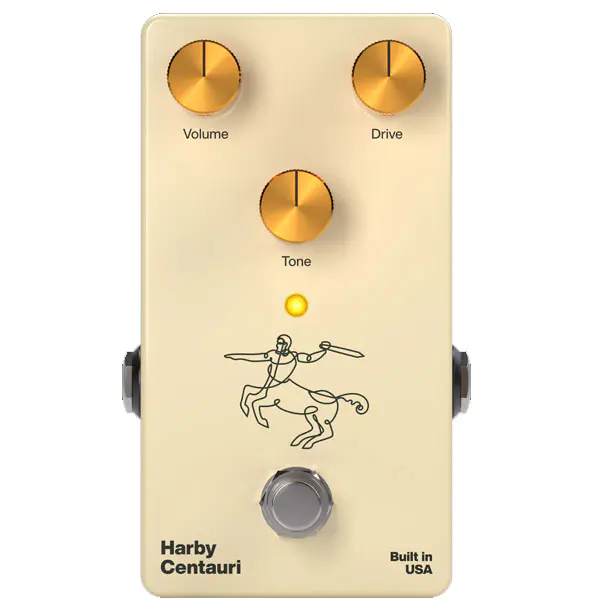
The Harby Pedals Centauri is – as you may gather – is, circuit-wise, a Klon clone, embedded in a compact case much smaller than the original. Selling at $169, it’s about 1/30th the price of an original Klon Centaur, using several components as the original and the same 3-knob layout.
Just like the Klon, it’s also hand-built in the US – Idaho to be exact – by Joe Harby, a tech junkie who created this company to design recreations of rare pedals. To this day, his roster includes also clones of the Prince of Tone the Sovtek Big Muff.
Here’s the demo of the Centauri, we added it to our article about the best Klon Centaur clones.
Harby Pedals Centauri, Builder’s Notes
Modeled directly after its predecessor’s circuit board, the Klon Centaur, Harby Centauri is built using the highest-quality components to give you that rich, clear Centaur sound without the Centaur price tag.
In 1994, Bill Finnegan made a legendary contribution to the guitar industry: the Klon Centaur overdrive stomp pedal. With a clear, well-articulated sound that’s free from synthetic, solid-state distortion and unnecessary heaviness, the Centaur became a favorite among guitarists everywhere, and its popularity hasn’t declined since.
Not everyone could get their hands on one, though. Finnegan only built 8,000 units, and these days, they command prices in the neighborhood of $7,000. So naturally, many guitarists opened up Centaurs to study the circuit board schematics in order to copy them and build their own. For years, these guitarists were thwarted by a thick layer of epoxy coating every Centaur circuit board. It wasn’t until 2009 that Martin Chittum finally managed to remove the resin from a Centaur and the schematics were revealed.
Like our fellow pedal junkies, we decided to recreate the Centaur to take up less space on your stomp board without sacrificing the original’s clarity and sweetness. Using the original circuit board design and parts that Finnegan himself relied on, the Harby Centauri can be used on any pedal board for a huge range of applications. Use it on its own to juice up your output, get a clean boost with the drive knob turned all the way down, or combine it with fuzz and distortion pedals to add a slightly thicker character to their heavy grit. And with its buffered bypass, the Centauri, like the original Klon Centaur, is never truly off—its mellow, clear tone can always be relied on in the studio and on-stage.
All that said, we’d never claim that the Centauri is a perfect sonic match to any Klon. Finnegan himself said that the sound varied from Centaur to Centaur, due to the nature of the clipping diodes he used. We’ve simply attempted to replicate the Centaur’s quality and richness through a faithful reconstruction according to Finnegan’s specifications. The results speak for themselves.