




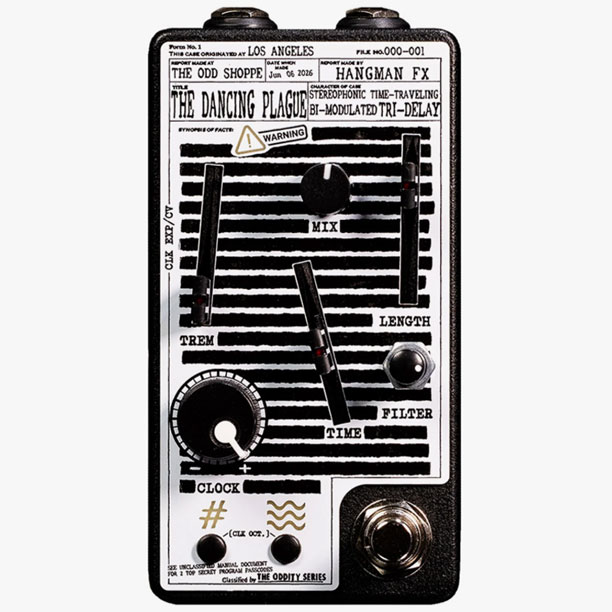
Hangman fx is a one-man operation from Los Angeles with a thing for strange pedals: we have covered the Meteoric Echo Monster delay and the Atomic World Ender octave fuzz on here before. The Dancing Plague is the first pedal in his new Oddity Series, a line inspired by unexplained events in history. This one is named after the Strasbourg dancing plague of 1518, when a woman started dancing in the street and hundreds joined her over the following days, some until they collapsed. Nobody knows why it happened. The pedal is a stereo delay, and the name fits it better than you would expect.
Hangman calls it a “Stereophonic Time-Traveling Bi-Modulated Tri-Delay,” and for once the long name is a fair description. It is a stereo digital delay with up to three taps, two kinds of modulation built in (a tremolo, and a chorus/vibrato Hangman calls TouchSwirl), six color-coded programs and two hidden ones. It costs $230, direct from Hangman’s webstore.
What’s Special About It
The Clock knob. It controls the sample rate of the whole effect, and you can turn it down to about 3 kHz. Everything slows down together, delay, tremolo and modulation, like a record player losing speed: at the bottom you get 10-second delay times, and below halfway the sound degrades from cassette-style lo-fi into full bit-crushed destruction (there is an analog low-pass filter to tame it). Push the two small buttons together and the same knob works in different ways: exact octaves, for pitch-shifted repeats, or time divisions from 1x down to 1/16. Hold the buttons longer and you get a Top Secret clock mode where the clock jumps between octaves at random. On top of that, you can record up to 10 seconds of Clock knob movement and the pedal plays it back on its own, like a hand-drawn LFO. The recording survives powering the pedal off.
The other unusual idea is the Divergent Delay Time, used by four of the six programs. On a normal multi-tap delay the taps stay locked to one time. Here, moving the Time slider changes all three taps in different, unsynced ways, one faster, one slower, one logarithmic, so a small move produces a completely new rhythm. Push the repeats up and the taps blur into each other, which is why Hangman nearly called this pedal a “deconstructed reverb.”
Most Intriguing Controls:
- Clock: Covered above. It is the control this pedal is built around, and it also takes expression/CV input (Chase Bliss-style TRS, floating ring), so Hangman’s own light-sensitive Luma Express or pressure-based StompExpress, or any standard expression pedal, can drive it.
- TouchSwirl (wave button): The second modulation. It is linked to your input signal, so it blooms as you play and fades as the notes decay, chorus in some programs, vibrato in others. Hold the button down for a single warble, on demand.
- # Button: Steps through the six programs, each with its own LED color and a fixed recipe: Divergent triple-tap in dual-mono or ping-pong, a synced double tap, or a plain single tap, with different TouchSwirl and tremolo depths and types for each. The settings (not the knob positions) are saved automatically when you power down.
- Top Secret Programs: Two hidden modes. Footswitch + # gives a single delay where the Trem slider becomes a pitch slider, sweeping the repeats from -1 to +1 octave. Footswitch + the wave button gives the Haunted Alien Raindrop Delay, where the repeats are slowly pitch-shifted and resonantly filtered, like a tape head speeding up and slowing down.
Other Controls:
- Sliders and Knobs: Tremolo speed, Length (repeats; at 100% it oscillates), Mix and the analog Filter, plus a warning LED that lights up when the input is clipping.
- Footswitch: Intelligent soft-switching: a normal stomp bypasses it, holding it for more than 350 ms makes it momentary. The bypass is buffered, with three modes set at power-up: with trails, without trails, and a third, secret one that keeps your Mix volume the same whether the pedal is on or off, so you can bypass and play over the trails without a volume jump.
- Inside the Pedal: A mono/stereo input switch, left and right output trimmers (up to about +10 dB of clean boost), and a trimmer for the TouchSwirl depth. Stereo in and out are on TRS jacks, so it handles mono-in/stereo-out and full stereo setups.
The Word on the Street
Coverage is still thin, but the one reviewer who has lived with the pedal, the one and only Stephan at Guitar Pedal X, has written about it twice and at length. He calls it a work of genius and “probably the best ever compact delay,” and in his October pedal-chain update it was the highlight of his month; his default is program 2 (Blue), the ping-pong Divergent setting. His one warning, echoed by PedalFinder’s overview, is that the two push-buttons and their combinations take some learning. The Boring Gear Reviews demo (below) comes to a similar conclusion from the playing side: “calling it a delay is underselling it,” and “the longer I played it, the weirder it got, in a good way.”
If you are bored with normal delays, this is a compact, $230 box that does things no other compact delay we know of does, starting with recording its own knob movements. Whether the button combinations become second nature is the open question. Our other Hangman fx posts are under the Hangman fx tag. Check out the videos below, including Hangman’s own full video manual, which this pedal genuinely needs.
– Paolo De Gregorio