




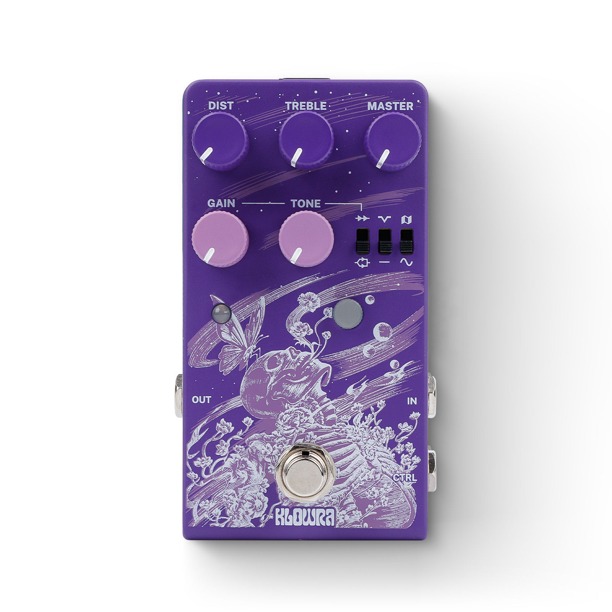
The Klowra Gnash is a departure for the Chinese brand. The Klowra pedals we have covered so far, the Limbo reverb and the Everlast delay, are DSP designs. The Gnash is analog, all the way through the signal path: two distortion channels built with through-hole components, with digital control (Klowra calls it WildSeed) handling the switching. It is part of the Bloom Infinity series, which means hand-painted-style silkscreen artwork, in this case a purple enclosure that is hard to miss.
The idea is simple: a main distortion channel (Dist, Treble, Master) and a second, simpler channel (Gain, Tone) that you can add to it. The second channel can feed the main one in series, like a boost pushing it into more saturation, or run in parallel with it, which adds body while keeping the attack of the main sound. Three slide switches set the texture, the EQ voicing and that routing. It costs $109.99, which, for what is inside, is not a lot.
What’s Special About It
Two things. The first is the Wavefolder. Instead of only clipping the signal, in Wavefolder mode the pedal folds the waveform’s peaks back on themselves, which adds upper harmonics and pushes the distortion towards fuzz: a subtle edge at low settings, something close to a synth-like grit when you push it. The second is Snap-Mod: hold the LED button and the pedal saves your current slide-switch settings as a snapshot; hold the footswitch and it jumps to that snapshot instantly. It is a preset, of a limited kind, on a $110 analog pedal with no screen and no menus.
Most Intriguing Controls:
- Wavefolder / Hard Clip (right switch): The texture switch. Hard Clip is a tight, classic hard-clipping distortion; Wavefolder is where the fuzz-like, harmonically messy sounds live.
- Stack / Parallel (left switch): Only works when the second channel is on. Stack runs it into the main channel in series for more gain; Parallel runs it alongside, for thickness without losing definition.
- Mid Cut / ’90s Black-Box EQ (middle switch): The EQ voicing. Mid Cut scoops the mids in the classic metal style; the other position recreates the voicing curve of a certain ’90s black distortion box.
- Snap-Mod: One saved snapshot of the three switch positions, recalled by holding the footswitch. Simple, and genuinely useful live.
Other Controls:
- Secondary Channel: Gain and Tone knobs that only do anything when the channel is engaged, via the LED button on the pedal or an external footswitch.
- CTRL Jack: A TRS input for an external momentary footswitch: a single switch toggles the second channel, a dual switch (like Klowra’s own Animus) also toggles Snap-Mod. Expression pedals are not supported.
- Power-Up Modes: Hold the footswitch while powering on to set the external triggers to momentary or latched, and to adjust the LED brightness.
The Word on the Street
The Gnash has been reviewed properly, and the reviews are enthusiastic. Our friend Stephan at Guitar Pedal X calls it his favourite Klowra pedal so far and one of the most versatile multi-gain pedals he has tried at any price, which is strong praise at $110. Guitar Gear Finder’s review, which includes audio clips of the two channels combined in different ways, makes the more practical point: this is a distortion that can be dialed to genuinely different styles, not one sound with variations. Pedal of the Day, in a review published this week, calls it a “big, bold and extremely unique dirt pedal.” The one recurring caveat is worth knowing: the controls are interactive and sensitive, so small movements can change the gain a lot. Budget a few minutes to learn it.
If you like the idea of one analog distortion that covers boost, overdrive, distortion and a good amount of fuzz, and you do not mind a pedal that asks you to tweak it, the Gnash is easy to recommend at this price. You can find our other Klowra coverage under the Klowra tag. Check out the videos below.
– Paolo De Gregorio