




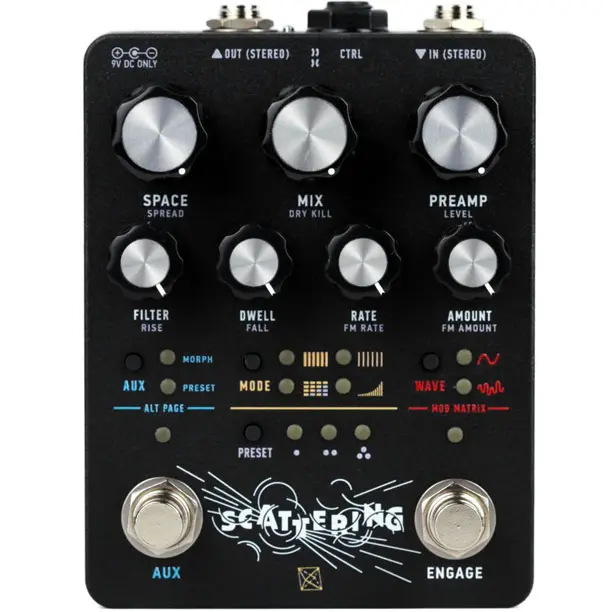
Stepping away from traditional, diffuse ambient washes, the Electronic Audio Experiments Scattering approaches spatial processing through a complex multi-tap delay network that feels refreshingly alive.
Tracing its spiritual roots back to EAE’s earlier Hypersleep – which was ultimately limited by exhausted supplies of the rare MN3011 bucket brigade chip – Scattering utilizes a powerful Spin FV-1 digital architecture to bring those vintage-inspired, multi-tap ideas into a much more capable, modern format. It’s a hybrid instrument that balances a high-headroom analog dry path with 24-bit digital processing, ensuring your core tone stays crisp even when things get wonderfully chaotic.
Shaping the sound is handled by seven primary controls spread across two rows, letting you dial everything from tight room tones to vast, disintegrating sonic voids.
At its core, the pedal features four distinct algorithmic modes:
- X1 Mode: Directly ports the six tap lengths from the classic MN3011 BBD architecture.
- X2 Mode: Doubles those tap lengths to push the pedal deep into expansive, long-delay territory.
- Matrix Mode: Runs eight total delay lines (four per side) through a Feedback Delay Network (FDN), providing enough stability to hold a true infinite reverb.
- Nonlinear Mode: Employs a swelling envelope applied directly across the delay taps for unique rhythmic breathing.
Expanding on the control layout, the Scattering features seven front-panel knobs spread across two distinct rows, alongside a comprehensive set of secondary “Alt” functions and routing tools to give you deep command over your spatial environment:
-
Top Row Controls: Space adjusts the individual delay tap length by varying the underlying DSP sample rate; Mix blends the post-preamp signal against the reverb output from fully dry to fully wet; and Preamp acts as a stereo analog gain stage at the input, driving both the wet and dry paths before the effect hits the digital core.
-
Filter and Modulation Controls: Filter introduces a stereo two-pole analog low-pass filter on the reverb output with a cutoff extending into the infrasonic range; Dwell applies feedback directly to the reverb taps; and LFO Rate and Amount bring in modulation to animate the sound.
-
Secondary Alt Functions: Holding down secondary commands unlocks additional parameters including Spread, Dry Kill, Level, Morph Rise, Morph Fall, FM Rate, and FM Amount.
-
Modulation Matrix & LFO: An onboard LFO featuring selectable sine and random waveforms can be assigned to virtually any parameter using the mod matrix equipped with bipolar attenuverters, capable of everything from sluggish tape wobbles to audio-rate FM cacophony.
-
Stereo & Spatial Adjustments: A dedicated Spread control varies the stereo image from a dual-mono field to ping-pong echoes, while a MISO (mono in, stereo out) toggle feeds a mono source into both channels for immediate widening.
-
Performance & Control Options: Supports seamless morphing between two complete control states (with adjustable rise and fall times and momentary or latching footswitch behavior), 16 preset slots (3 accessible from the front panel and 13 via MIDI), and full MIDI implementation across all parameters.
Beyond its core architecture, Scattering is packed with deep performance features. An onboard multi-mode LFO can animate any parameter via a flexible mod matrix with bipolar “attenuverters,” stretching from slow, subtle tape warbles to audio-rate FM textures. With full stereo I/O, expression morphing capabilities with adjustable rise and fall times, 16 total preset slots, and full MIDI implementation, it’s a deeply thoughtful and immensely playable hybrid tool that invites you to get lost in the details.