




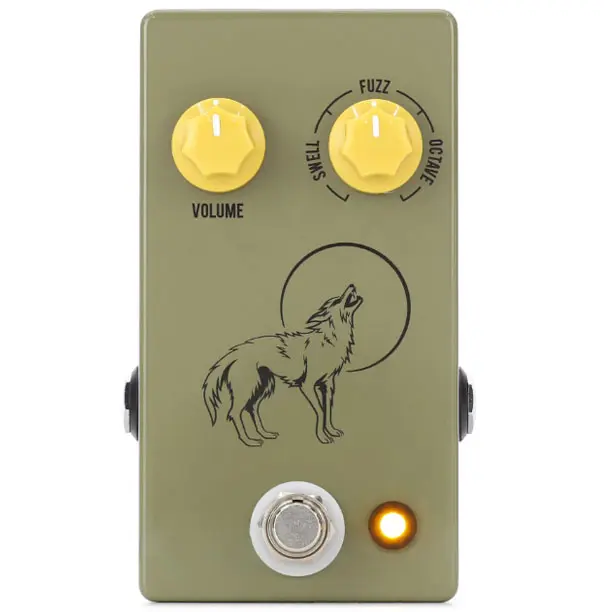
Josh Scott has made a career of digging up lost circuits and handing them back to guitar players. The JHS Coyote Fuzz is his tribute to Glenn Wyllie, a North Carolina builder who’s been soldering transistors since the ’60s and somehow never became a household name. Wyllie’s Moonrock fuzz was the source. A weird, transformer-based octave fuzz that sounded like nothing else. JHS took that blueprint and let it breathe.
Two knobs. Volume and Mode. That’s it. The Mode knob sweeps continuously through three zones:
- Swell: The slow bloom setting. Notes don’t attack—they breathe. Gated, reverse-tape character that swells in behind your pick. At its lowest, it’s responsive, gradual, unlike any fuzz you’ve auditioned. Perfect for slow builders and ambient creep.
- Fuzz: Midrange-forward. Full low end. Aggressive mids that cut without being harsh. At noon, it’s a powerful, rich fuzz that sits right in the mix.
- Octave: Upper-harmonic snarl. Aggressive octave-up that channels late ’60s Hendrix and Stones territory, but through Wyllie’s unconventional transformer circuit . Not an Octavia clone. Something else entirely.
The Coyote is touch-sensitive in ways octave fuzzes usually aren’t. Roll back your guitar volume and it cleans up. Dig in and it responds. It’s a living circuit, not a static effect .
Wyllie spent more time developing the original Moonrock than he spent with his girlfriend, and she let him know it . That obsessive care is in the DNA. JHS just made sure it survived.
Five milliamps. True bypass. Compact footprint. A piece of fuzz history that doesn’t require a museum membership.