



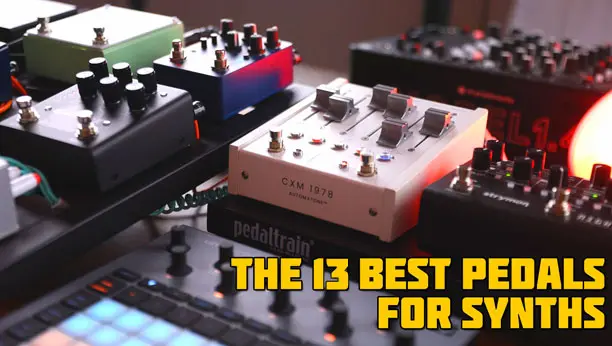
Three years ago, we made a plan. Ten videos with synth influencer Liam Killen, breaking down the best synth pedals by effect type. Nice and tidy. What could go wrong?.
Everything. In the best way possible.
That tidy little series spiraled into a two-and-a-half-year obsession. We dove into multi-modulation, got lost in reverb, argued about granular delay, and emerged with opinions we didn’t have when we started. Now we’re finally surfacing for air.
Here’s the condensed version: one essential pick for thirteen categories. A few caveats, though. We took some liberties. These are our favorites, not necessarily Liam’s, although we share many favorites – you can find his here.
So grab a coffee. Or something stronger. Let’s end this thing properly.
• BEST MONO EQ/FILTER PEDAL FOR SYNTHS
Read the full article: Filter and EQ Pedals for Synths
Empress Effects Para EQ Deluxe
[ VIDEO | Check Price on Sweetwater ]
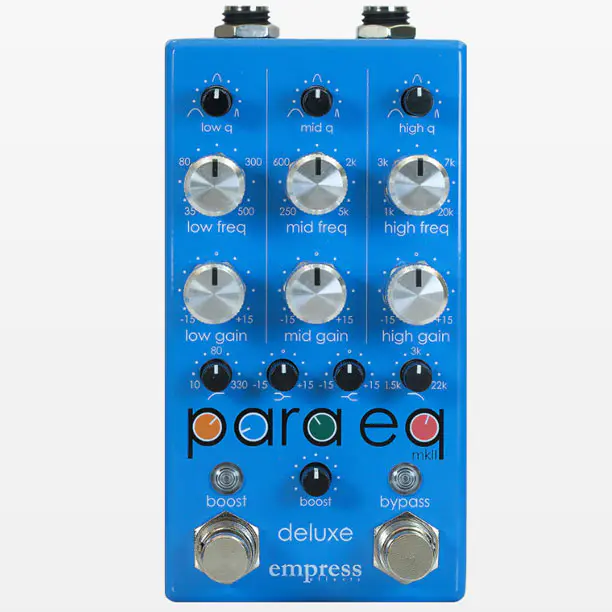
The Empress Effects ParaEQ Deluxe stands out as a powerful, fully analog studio-grade equalizer in pedal form. It features three fully parametric bands (Low, Mid, High), each offering +/- 15dB of gain. True parametric control means you can adjust the frequency, level, and bandwidth (Q) for surgical precision. A dedicated footswitch engages a separate +30dB Clean Boost, making it ideal for solos or driving your amp.
Beyond the core bands, the Deluxe version adds a flexible high-pass/low-pass filter section, switchable between shelving and bell curves, and a versatile EQ-Shape toggle for each band (Wide/Normal/Narrow). This allows for everything from broad tonal shaping to extremely focused notching.
Compared to the standard ParaEQ, the Deluxe model replaces fixed-Q switches with continuous Q knobs and adds the filter section for greater versatility. While it lacks MIDI and is mono, its true bypass switching, robust construction, and comprehensive control make it a top choice for sculpting tone at your feet. For synth users, its wide frequency range and headroom are particularly valuable.
—
• BEST STEREO EQ/FILTER PEDAL FOR SYNTHS
Read the full article: Filter and EQ Pedals for Synths
BOSS EQ-200
[ VIDEO | Check Price on Sweetwater ]
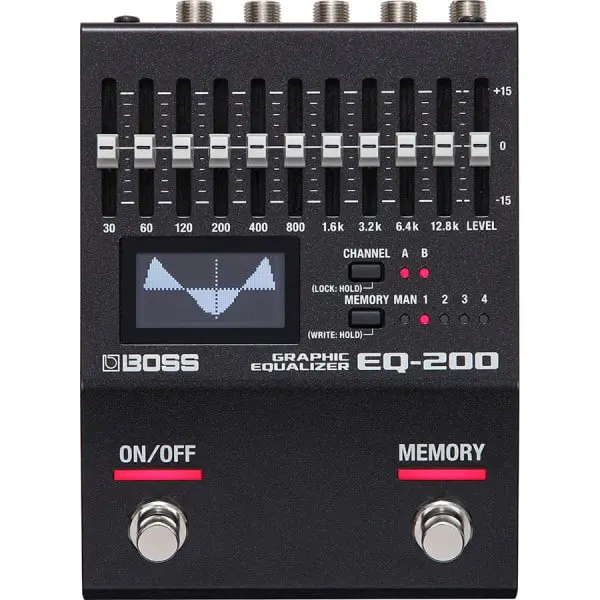
The EQ-200 is a dual 10-band equalizer that brings studio-grade automation to pedal format. Its core innovation is flexible routing: two independent EQs run in stereo (left/right channel processing), parallel (separate EQ on a single source), or series (stacked for radical filtering). This architecture makes it extremely appealing for integration with synth rigs, drum machines, and stereo mix processing.
Full MIDI implementation over TRS jacks enables 128 preset recalls and continuous parameter automation. Trigger EQ curve changes from a sequencer, morph between bass-heavy and cutting tones via an expression pedal, or let your DAW automate frequency sweeps in real time. The internal 32-bit/96kHz signal path ensures pristine fidelity through all processing.
A backlit graphic display shows your EQ curve in real time, which is especially useful when thinking in frequencies rather than knob positions. Three adjustable frequency range presets optimize the EQ-200 for electric guitar, bass, or broader full-spectrum sources like synthesizers and samples.
At $270, this is an EQ that belongs on the desk, not just the board – and its automation capabilities change everything.
—
• BEST PREAMP PEDAL FOR SYNTHS
Read the full article: Distortion Pedals for Synths

JHS Colour Box 2
[ VIDEO | Check Price on Sweetwater ]
The JHS Colour Box V2 is a meticulous recreation of a classic Neve console channel strip in a compact, fully analog stompbox. This makes it the perfect cornerstone for any exploration of saturation, as the very first iconic distortion tones—including the legendary first fuzz sound—were born from overdriven console preamps.
The circuit is driven by three red gain knobs: Input, Output, and the critical “Step” control. The Step knob selects between five discrete gain stages (+18dB, +23dB, +28dB, +33dB, +39dB), pushing the pristine Neve-style preamp from clean boost into rich harmonic overdrive and finally into a textured, fuzzy saturation. A “Hi” gain toggle further increases sensitivity for earlier breakup.
True to its studio heritage, it features a full 3-band parametric EQ (with adjustable frequency and level for low and high bands) for surgical tonal shaping, plus a high-pass filter. While it’s a mono pedal without modern features like MIDI, the Colour Box V2 offers an authentic, hands-on path to the foundational tones of rock history, directly at your feet.
—
• BEST DISTORTION PEDAL FOR SYNTHS
Read the full article: Distortion Pedals for Synths
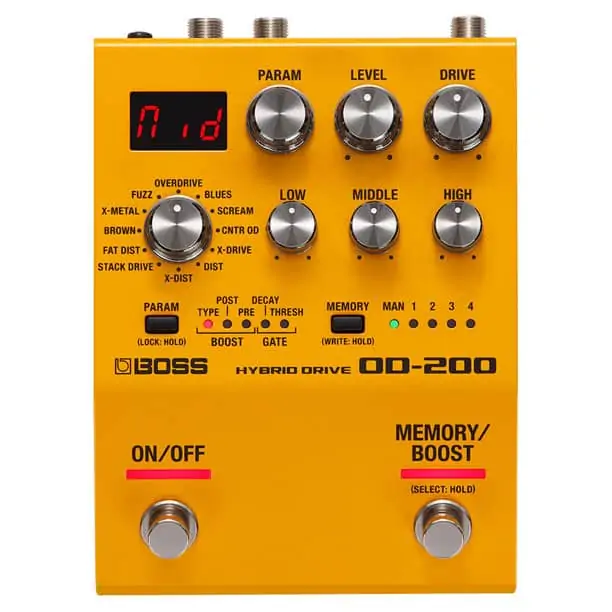
BOSS OD-200
[ VIDEO | Check Price on Sweetwater ]
The BOSS OD-200 represents the modern zenith of distortion in a single pedal, masterfully blending analog drive circuits (the core tone-shaping and clipping components) with digital control and versatility. It houses 12 distinct algorithms that meticulously model legendary vintage pedals, classic amp drives, and venture into unique, experimental, and fuzzy territories.
Beyond its core tones, it is packed with professional features. A dedicated footswitch controls a clean boost (assignable pre- or post-drive) for solos or emphasis. Its effective 3-band EQ and configurable noise gate offer essential tone shaping, with the gate being particularly useful for creating sharp, gated effects on synths and drums.
The OD-200 excels in flexibility and recallability. With MIDI compatibility, 128 preset slots (4 directly accessible via the pedal), stereo operation, and an effects loop for integrating other pedals into its signal chain, it is a powerful, all-in-one tonal workstation for the musician seeking dirt.
—
• BEST LO-FI PEDAL FOR SYNTHS (TAPE-STYLE)
Read the full article: Best LoFi Pedals for Synths
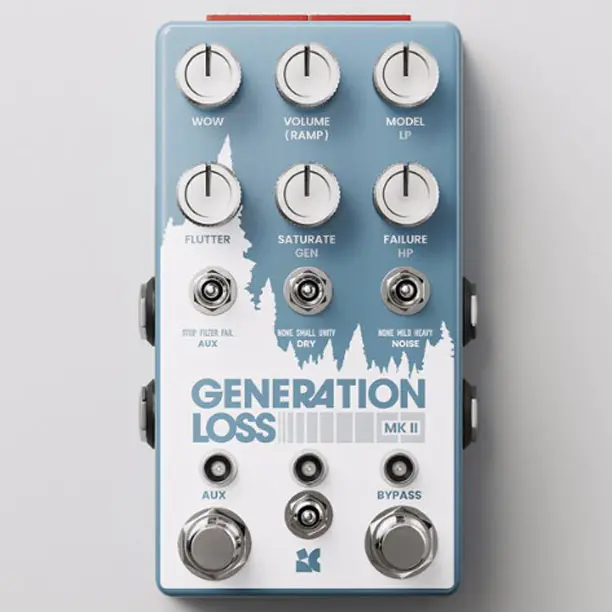
Chase Bliss Generation Loss MkII
[ VIDEO | Check Price ]
The Chase Bliss Generation Loss MkII is a comprehensive stereo reimagining of the cult-classic Cooper FX pedal, now built in-house by Chase Bliss after the original designer joined their team. This “VHS-in-a-box” device meticulously emulates the warm, degraded artifacts of analog tape media.
It operates in two distinct modes: Classic faithfully replicates the exact sound and deep-editing capability of the original MkI, while MkII introduces new, even more authentic models of specific tape machines, wear levels, and circuit-based failures like head crinkle and motor wobble. Both modes provide an overwhelming level of control—via six knobs, four toggles, and 16 internal DIP switches—to dial in everything from subtle tape hiss and wow/flutter to extreme dropouts and catastrophic signal degradation.
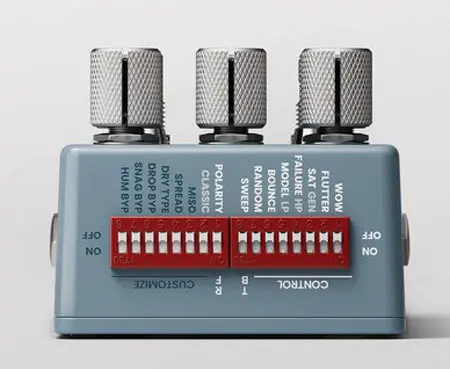
Built for the modern studio, it includes full MIDI and CV control, eight onboard presets, and the brand’s signature “Ramp” functionality for smooth, automated parameter sweeps via its Aux footswitch or external expression. The Generation Loss MkII transforms pristine signals into beautifully broken, nostalgic textures, offering endless sound design possibilities for synth players and producers.
—
• BEST LO-FI PEDAL FOR SYNTHS (BIT-CRUSHERS)
Read the full article: Best LoFi Pedals for Synths
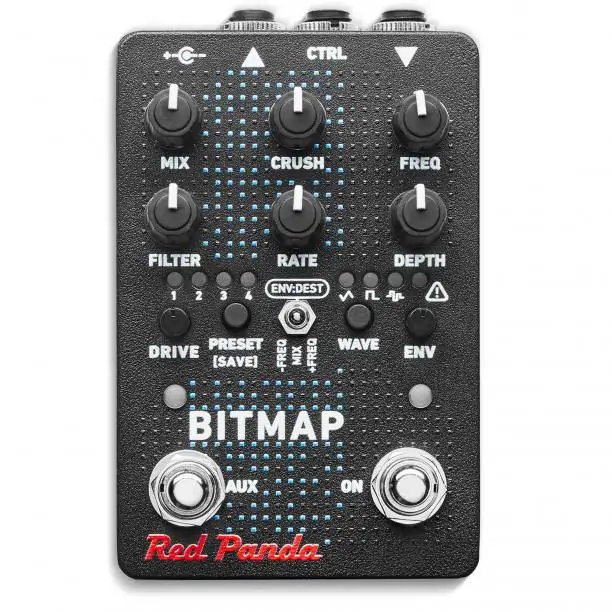
Red Panda Bitmap 2
[ VIDEO | Check Price on Sweetwater ]
Far beyond a simple lo-fi effect, the Red Panda Bitmap 2 is a sophisticated digital signal processor that specializes in the creative degradation and mangling of audio. At its core are comprehensive bit-depth and sample-rate reducers for classic digital grit. These feed into powerful and unique wavefolding and filtering stages, allowing you to sculpt everything from warm, analog-voiced saturation to extreme digital distortion and resonant chaos.
Its true magic lies in the deep modulation matrix. You can modulate the sample rate, mix, or filter cutoff using LFOs with multiple waveforms (sine, square, random) or assign the movement to an envelope follower. This transforms static textures into dynamic, evolving soundscapes.
Designed for expansive setups, it features MIDI control, CV inputs for modular integration, and four onboard presets. An expression pedal input allows for real-time, nuanced control. While complex, the Bitmap 2 rewards experimentation, turning sonic annihilation into a profoundly musical and inspiring tool perfect for synths, guitars, and sound design.
—
• BEST MODULATION PEDAL FOR SYNTHS
Read the full article: Best Modulation Pedals for Synths
Walrus Audio M1 MkII
[ VIDEO | Check Price on Sweetwater ]
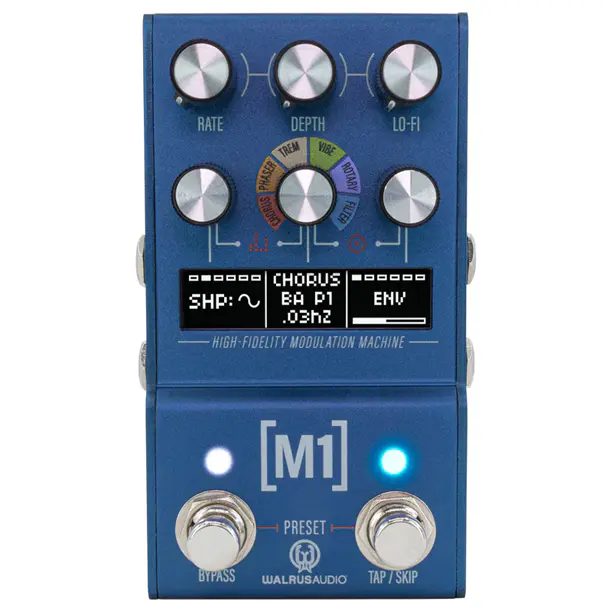
The Walrus Audio Mako M1 MkII is a stereo multi-modulation powerhouse in a compact chassis, now updated with an intuitive OLED screen for easier navigation. It hosts six core effects: Phaser, Chorus, Tremolo, Vibrato, Rotary, and Filter, each with three distinct algorithms (“Voices”).
The defining feature is its brilliant Lo-Fi control. This parameter injects everything from subtle tape saturation and wow/flutter to pronounced vinyl crackle and bit-crushing into any mode, allowing seamless blends from pristine to perfectly degraded tones.
Its versatility is staggering. Two assignable footswitches handle tap tempo, preset cycling, and momentary effects. The secondary “Tweak” and “Tune” knobs, along with the Voice toggle, unlock deep parameter editing—like LFO shape, envelope sensitivity, drive, tone, and even a playful “Skip” function that emulates a record needle jump. The MkII version notably adds an expression pedal input and a much-requested Flanger mode, addressing the main critiques of the original.
With 128 presets (8 directly accessible via the pedal), full MIDI implementation, and a stereo signal path, the M1 MkII is an exceptionally creative and studio-ready tool for synthesists seeking both classic modulation and distinctive, character-filled sound design.
—
• BEST REVERB PEDAL FOR SYNTHS
Read the full article: Best Reverb Pedals for Synths
Chase Bliss CXM 1978
[ VIDEO | Check Price ]
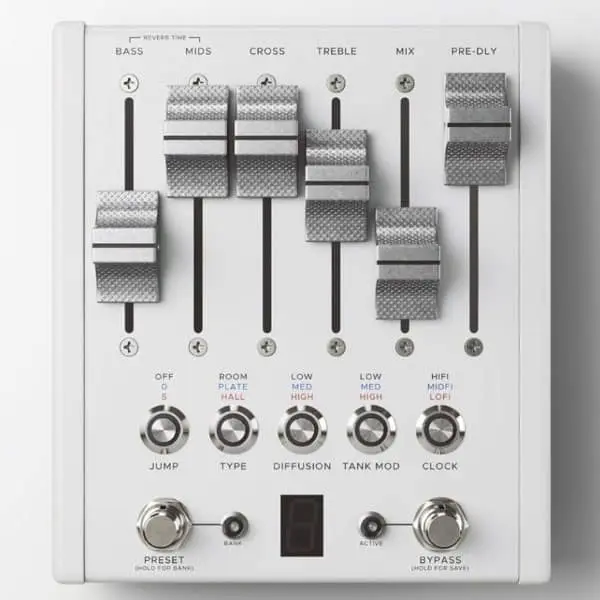
The Chase Bliss CXM 1978 is a faithful and luxurious hardware adaptation of the legendary 1978 Lexicon 224 studio reverb, developed in collaboration with Meris. It features pristine 32-bit AD/DA conversion and offers three iconic, fully stereo algorithms: Hall, Plate, and Room. Each algorithm is profoundly shapeable with discrete settings for Diffusion, Modulation, and a unique “Clock” control. This Clock parameter is key to its character, emulating the grainy tails and multi-delay artifacts of early digital hardware at lower settings for authentic vintage texture, or providing pristine clarity at its highest.
Housed in the brand’s signature Automatone format with moving motorized faders, the pedal excels at creating morphing, evolving soundscapes. You can manually or automatically crossfade between two complete snapshots, or use MIDI for precise, automated parameter sweeps.
Designed with modern production in mind, it includes a dedicated Lo-Fi mode for more extreme digital degradation, an adjustable Decay Crossover for sculpting the reverb tail’s behavior, and comprehensive studio connectivity. The CXM 1978 masterfully bridges the iconic sound of studio history with cutting-edge, performable control.
—
• BEST DELAY PEDAL FOR SYNTHS
Read the full article: Best Delay Pedals for Synths
Meris LVX
[ VIDEO | Check Price on Sweetwater ]
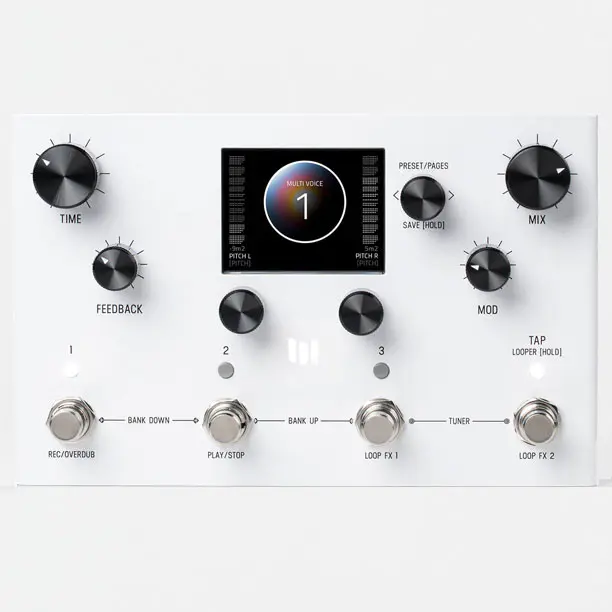
The Meris LVX reimagines the modern delay pedal as a modular, algorithmic synthesizer for sound. At its core is a dynamic engine where you construct your own effects by pairing a core digital delay line with a chain of up to three processors from a deep library. This library includes iconic algorithms from other Meris pedals (like the Hedra’s pitch shifting or the Ottobit Jr.’s bit-crushing) alongside powerful new additions like granular synthesis, cassette emulation, and polyphonic pitch shifting.
Interaction is centered around a vibrant, animated color LCD that provides immediate visual feedback for deep editing. Four primary knobs control essential delay parameters (Time, Feedback, Mix, and a multi-function “Mod/Alt” control), while two additional knobs are freely assignable for real-time control of any parameter.
Designed for expansive rigs, it features two stereo effects loops with dedicated footswitches for on-the-fly routing, a fully-featured looper, and comprehensive MIDI control with 128 presets. The LVX transcends typical preset-based workstations, offering a uniquely creative and open-ended platform for designing intricate delays, textured soundscapes, and complex modulation effects from the ground up.
—
• BEST GRANULAR PEDAL FOR SYNTHS
Read the full article: Best Granular Pedals for Synths
Red Panda Particle 2
[ VIDEO | Check Price on Sweetwater ]
The Meris LVX reimagines the modern delay pedal as a modular, algorithmic synthesizer for sound. At its core is a dynamic engine where you construct your own effects by pairing a core digital delay line with a chain of up to three processors from a deep library. This library includes iconic algorithms from other Meris pedals (like the Hedra’s pitch shifting or the Ottobit Jr.’s bit-crushing) alongside powerful new additions like granular synthesis, cassette emulation, and polyphonic pitch shifting.
Interaction is centered around a vibrant, animated color LCD that provides immediate visual feedback for deep editing. Four primary knobs control essential delay parameters (Time, Feedback, Mix, and a multi-function “Mod/Alt” control), while two additional knobs are freely assignable for real-time control of any parameter.
Designed for expansive rigs, it features two stereo effects loops with dedicated footswitches for on-the-fly routing, a fully-featured looper, and comprehensive MIDI control with 128 presets. The LVX transcends typical preset-based workstations, offering a uniquely creative and open-ended platform for designing intricate delays, textured soundscapes, and complex modulation effects from the ground up.
—
• BEST ORGANIC MULTI-FX PEDAL FOR SYNTHS
Read the full article: Best MultiFX Pedals for Synths
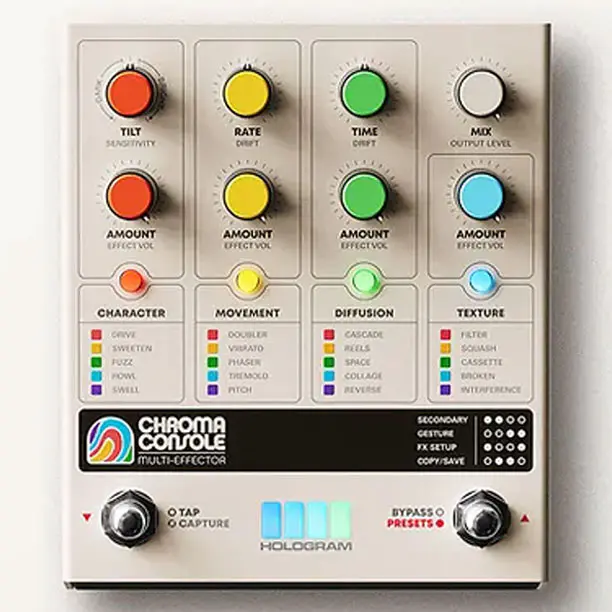
Hologram Electronics Chroma Console
[ VIDEO | Check Price ]
From Hologram Electronics, the innovative minds behind the bestselling Microcosm, comes the Chroma Console—a fully stereo, modular multi-effects engine designed to be a creative hub for sonic experimentation.
At its core is a flexible, rearrangeable signal chain of four effect modules. Each module hosts a selection from a deep library of 20 premium algorithms, including lush reverbs, textured delays, dynamic modulation, and the brand’s signature pitch and granular processors. You can freely reorder these four modules, enabling instant exploration of radically different signal paths and textures without repatching cables.
The Chroma Console is built for both inspiration and precision. Unique features like GESTURE (which records and loops your knob movements) and CAPTURE (a sophisticated sustain and loop buffer) turn performance into composition. Meanwhile, the DRIFT parameter injects a customizable amount of analog-style randomness and lo-fi warble for organic movement.
Designed for the modern studio and stage, it offers 80 user presets, comprehensive MIDI implementation (In/Out/Thru with clock sync), stereo I/O with instrument/line level switching, and true/buffered bypass with trails. The Chroma Console isn’t just another multi-FX; it’s an intuitive, boundless playground for transforming any sound into something extraordinary.
—
• BEST MODULAR MULTI-FX PEDAL FOR SYNTHS
Read the full article: Best MultiFX Pedals for Synths

Empress Effects Zoia
[ VIDEO | Check Price on Sweetwater ]
The Empress Zoia transcends the definition of a pedal; it is a modular synthesizer and programmable effects workstation contained within a compact stompbox (and also available in a Eurorack module). Its true power lies in its open-ended, patchable architecture, allowing you to construct virtually any effect, synthesizer voice, or utility processor from the ground up.
Using a grid-based interface, you connect modules from a vast library—including oscillators, filters, LFOs, envelope followers, sequencers, loopers, and dozens of audio effects—to create custom signal paths limited only by your CPU allocation and imagination. This enables the design of intricate multi-effects, generative ambient textures, unique modulation routings, or even stand-alone synthesizers.
Designed for the experimental musician, it features 64 user patch slots, comprehensive MIDI implementation (with a built-in Control Change to module converter), a stereo looper, and support for expression/CV control. While its learning curve is steeper than a traditional pedal, the Zoia rewards investment with unparalleled flexibility, making it the ultimate tool for crafting sounds that are entirely and uniquely your own.
—
• BEST CREATIVE MULTI-FX PEDAL FOR SYNTHS
Read the full article: Best MultiFX Pedals for Synths
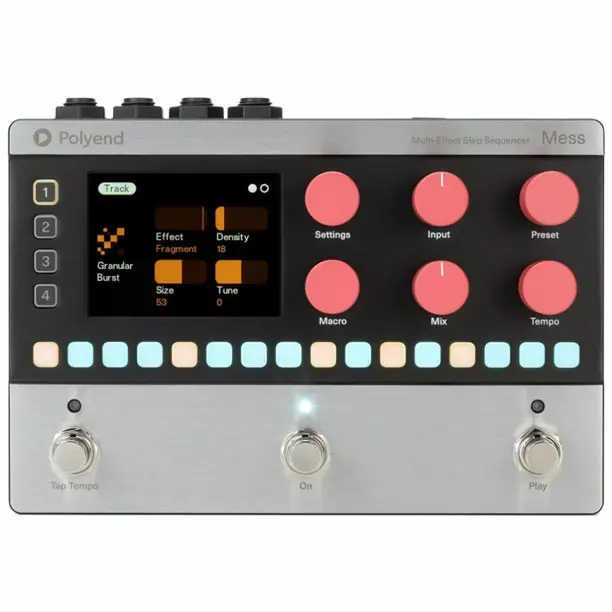
Polyend Mess
[ VIDEO | Check Price on Sweetwater ]
The Polyend MESS redefines the multi-effects pedal by fusing it with a powerful 8-track, 16-step sequencer, creating a dynamic instrument for rhythmic sound manipulation. Hailing from a renowned synthesizer and sequencer manufacturer, its core strength is in animating and reshaping audio with motion and intention.
At its heart are four independent, high-quality effect slots, drawing from a library of over 120 algorithms (including glitches, delays, reverbs, and bit-crushers). Each step of the 16-step sequencer can hold unique effect parameter settings, allowing for per-step programming to create complex, evolving, and glitchy rhythmic patterns. You can further modulate any parameter using four assignable LFOs or external MIDI.
This sequencer-driven workflow makes it uniquely suited for synthesists and producers. It transforms static pads into living textures, adds polyrhythmic stutters to leads, and generates lush, generative backgrounds. With comprehensive MIDI sync, external clocking, and a performance-oriented layout, the MESS is less an effect processor and more a collaborative instrument that brings sequenced, unpredictable life to any sound source.