Author Archive
![The Deli’s StompBox Exhibit in NYC!]()
This fall The Deli will present its first StompBox Exhibit in NYC. The event will be free for all, but due to the small size of the hosting venues, we recommend you RSVP HERE for a priority pass. Hosted at The Living Room’s Googies Lounge and Ludlow Guitar in the heart of Manhattan’s Lower East Side, the exhibit is scheduled for October 21 and 22, i.e. the busiest days of the CMJ Music Marathon 2011, an event which brings to the Big Apple thousands of musicians. Many big and small guitar pedal manufacturers will be present, including MOOG, TC Electronic, Line6, Eventide, T-Rex, Pigtronix and Z-Vex among others. Musicians are invited to bring their own guitars and plug in directly into the pedal boards. They will be able to test the pedals and hear the results directly in the headphones, which will be plugged into an amp emulation unit.... Click on the title for more
![Alesis iO Dock: Connect Pro Audio Gear to your iPad]()
There are a lot of mind-bending music apps for Apple’s iPad, utilizing the large touch-screen interface and built in accelerometer to create unique virtual instruments, multitrack recorders, and drum machines (So far, this one is my favorite). However, despite the ever-increasing number of music production apps, there are much fewer ways to actually connect your own gear to the popular tablet, leaving a wide range of creative possibilities unexplored. Enter the iO Dock ($199 street) from Alesis, a universal iPad and iPad 2 docking station designed to integrate virtually any instrument or piece of pro audio gear with your iPad. Slip your iPad into the side of the dock, and you’ve got a portable and functional workstation, with all of the connections you need to plug in professional microphones, instruments, and monitors. With the entire App Store at your disposal (the iO Dock is CoreMIDI compliant), you can fully utilize multitrack recorders like GarageBand, play the iPad like an instrument, or use it to control instruments through MIDI. For inputs, the dock has two combination XLR-1/4” jacks, with individual gain knobs and switchable phantom power for the pair. The second input also has a high-impedance switch, allowing you to plug […]... Click on the title for more
![Seymour Duncan Twin Tube Classic and Twin Tube Blues]()
Seymour Duncan’s Twin Tube series are tube powered preamp/overdrive pedals. They come in three flavors: “Blues”, “Classic”, and “Mayhem”! Each of the two-channel pedals are powered by a pair of mil-spec (Military Spec), subminiature (very small), USA-made Phillips-Sylvania® dual triode tubes. According to Duncan, “Too often, inexpensive tube gear runs in “starved plate mode,” where the tubes are not actually helping to create the distortion. The high-plate voltage and 100% vacuum tube signal path allows the tubes to operate at their fullest potential and provide maximum dynamic range. The means you get the most gain and all the smooth tone you expect from a high-quality tube preamp.” I will second that. These pedals have a warmth and clarity I’ve not heard from any other overdrive pedals. I A/B’d the Twin Tube Classic and Twin Tube Blues against several of my favorite overdrive pedals (one was green, one was blue) on several different amps, and the difference was stunning. Both Twin Tubes offer a massive amount of gain, even on the rhythm channel. With a gain and a volume for each channel, you can get anything from a nice clean boost to a super-saturated overdrive. You could even use them as […]... Click on the title for more
![Tremvelope: Envelope Modulated Tremolo by Pigtronix]()
Pigtronix has combined a vintage-sounding optical tremolo with some futuristic features in the Tremvelope, which is envelope modulated and allows the dynamics of your instrument to alter the rate and depth of the tremolo effect. Not only does the effect vary with the intensity of your playing, it also sports a number of extra features (stereo outputs, expression pedal inputs, and envelope control settings) that allow you complete control over the resulting sound. Your basic tremolo controls are all present on the unit, including Speed, Depth, and Waveform, and the latter is switchable from sine wave to sawtooth. A stereo output is available, so you can send to two amps for wide rotary effects. There is also connectivity for two expression pedals: one for controlling the rate of the LFO – overriding the pedal’s speed control, and one which controls volume in mono, or panning if two amps are connected to the Tremvelope’s outputs. The Engage foot switch bypasses the circuit, and the pedal runs on 18VDC, providing lots of headroom. The really unique parts of this pedal come from its envelope control settings, which adjust the tremolo in various ways depending on the dynamics of what you’re playing. Three-way Depth […]... Click on the title for more
![The Redesigned Xciter Pedal from Aphex]()
Aphex has done a recent redesign of their guitar pedals, streamlining their Bass, Acoustic, and Guitar Xciter pedals into one unit – now simply called the Xciter (MSRP $249). Designed to add clarity and tightness to your guitar sound without altering the tone, the Xciter acts as more of an enhancement than an effect. The pedal uses technology from the Aural Exciter rack unit, which has been around for over 30 years, and can be found in countless recording studios today. The Aural Exciter is used to add punch, presence, and intelligibility to audio signals: it works by adding even order harmonics to a filtered split of the original signal, and mixing that back into the unprocessed signal. A Big Bottom circuit was later added to the unit, which increased the perceived loudness of bass frequencies without significantly boosting the overall level of the audio. The Xciter pedal combines over three decades of refinements to its namesake into one package that features a few easy-to-use controls. A harmonics control switches between suggested settings for bass, guitar, and acoustic guitar – tailoring the behavior of the pedal to the type of instrument you’re playing. The Lo Freq knob lets you select […]... Click on the title for more
![Jam: Guitar Input for iPad, iPhone and Mac]()
Apogee is introducing a high quality guitar interface for Apple devices, providing another option for guitar players who want a quick and easy way to record at home or on the move. Jam ($99) features a 1/4″ input and gain control, and it connects via USB to your iPad, iPod or Mac. Simply plug in your guitar or bass and hit record to get started – a status LED on Jam turns green when it’s connected properly, and red if your levels are too hot. Jam is designed to be plug-and-play, and works with Garageband, Logic, MainStage, and any other application that runs on Core Audio. It’s powered through USB, and provides 40dB of gain and 44.1kHz/24bit audio conversion. Apogee touts Jam as a high quality alternative to similar products like the iRig or AmpKit Link, and it’s the only one available that doubles as an interface for Mac computers in addition to portable devices. Jam is available March 31st, check out www.apogeedigital.com for more info. -Mike Bauer... Click on the title for more


 Creative
 Delay
Delay
 Dirt
Dirt
 Dynamics
 Filter+EQ
 Lo-fi
Lo-fi
 Modulation
 pitch
pitch
 Reverb
 Synth
Synth
 Shopping Guides
 Stompbox Exhibit
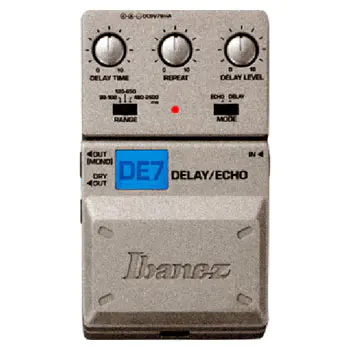
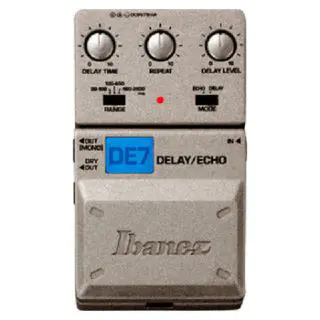
 The Ibanez DE-7 Delay/Echo is part of Ibanez’s Tone-Lok series of effects. At the time of their release, these pedals were geared toward the upcoming Nu-Metal scene but they have found their way onto the pedal boards of many different musicians due to their sturdy construction and great sounds.... Click on the title for more