




Hand-built by a small family operation in Toronto, Canada, Antif?n Audio’s pedals treat analog circuit design as a musical call-and-response. Studying classic vintage solid-state amps, studio gear, and pedals, the small team crafts original circuits delivering modern, discrete answers. Rather than chasing unobtainable NOS parts or building straight clones, they focus on clever, old-school discrete engineering that keeps your signal musical and expressive.
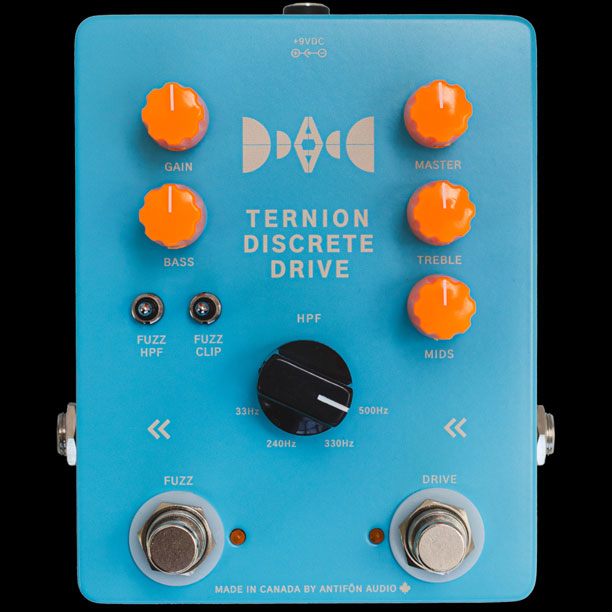
True to its name, the Ternion Discrete Drive stacks three Class A transistor gain stages—a nod to early-1960s solid-state circuits built as engineers transitioned away from vacuum tubes. Rather than relying on modern op-amp chips, this discrete setup behaves like a raw, old-school amp block, covering everything from clean boost and touch-sensitive overdrive to brassy, long-sustaining fuzz.
What’s Special About It
Discrete transistors don’t smooth out signal quirks the way modern ICs do, which makes the Ternion feel unusually alive under your fingers. Rolling back your guitar’s volume cleans it up nicely, especially if you place it first in your chain, though its healthy input impedance (~140k in Drive, ~70k in Fuzz) means it also takes stacked drives well. Stepping on the Fuzz footswitch pushes those three stages into a thick, horn-like fuzz loaded with midrange punch, subtle octave shimmer, and singing sustain.
Most Intriguing Controls:
- Fuzz Footswitch: Reconfigures the three transistor stages on the fly, transforming the pedal from a dynamic overdrive into a thick, brassy fuzz with singing sustain and hints of octave. Please note that the Drive footswitch operates as an on/off switch
-
HPF (High-Pass Filter): Controls both low-end tightness and overall gain structure, shifting from dark, saturated grit at lower settings to bright, treble-booster bite as you turn it up.
-
Fuzz HPF Toggle: Voiced specifically for Fuzz mode, this switch shifts the midrange boost point and alters circuit sag—moving from tight, high-gain crunch to loose, blooming fuzz.
-
Fuzz Clip Toggle: Changes headroom and compression in Fuzz mode, letting you choose between punchy, bass-heavy transients or squishy, octave-tinged sustain.
-
Mids: Operates an active notch filter centered around 850Hz, scooping out classic amp-style midrange space that fills right back in once you kick on the fuzz.
Other Controls:
-
Gain & Master: Dial in overall saturation (up to +30dB) and output volume across both modes.
-
Bass & Treble: Passive tone controls that tighten sub-lows (15Hz–175Hz) and tame high-end bite down to roughly 500Hz.
The Word on the Street
In his video of the pedal (below), Eirik Stordrange notes that the Ternion goes far beyond standard guitar-into-amp dirt. Because its three discrete transistor stages behave more like a mixing console channel strip than a traditional op-amp overdrive, it doubles as a versatile direct-in preamp—capable of gritty Tascam cassette-style lo-fi textures, rubbery flatwound bass tones, or saturated Peavey Decade-inspired parallel bass grit. Stordrange also highlights pushing a driven tube amp with the Ternion’s low-gain, high-master drive side, explaining that instead of shaving off low end like a typical overdrive, “you’re pushing every single frequency,” delivering instant early Queens of the Stone Age desert-rock weight.
If you love the raw, reactive feel of early transistor circuits and want one pedal that handles clean boost, dynamic overdrive, and expressive, mid-forward fuzz, the Ternion Discrete Drive is likely to cover every tonal nuance.